Books & Personal Development
Can’t Hurt Me by David Goggins Review: The Book That Makes Excuses Feel Embarrassing
David Goggins’ Can’t Hurt Me: Master Your Mind and Defy the Odds is part memoir, part mental-toughness manual, and one of the most forceful arguments against living below your potential. This review explains what the book is about, why it can be genuinely motivating, where its extreme message needs perspective, and whether it deserves a place on your reading list.
By Worth-the-cart
•
•
5 min read


This book does not gently invite you to improve your life. It grabs every excuse you have been protecting, drags it into the light, and asks whether you are finally tired of hearing yourself repeat it.
That is the real power of David Goggins’ Can’t Hurt Me: Master Your Mind and Defy the Odds. It is not simply a story about a Navy SEAL, an endurance athlete, or a man capable of tolerating extraordinary discomfort. It is a confrontation with the gap between what we say we want and what we repeatedly choose to do. Goggins’ life is so extreme that most readers will never attempt anything remotely similar, yet the everyday question beneath it is familiar: how much of my potential am I surrendering because discomfort arrives before progress does?
My short answer is that Can’t Hurt Me is absolutely worth reading for people who feel stuck, undisciplined, too comfortable, or frustrated by their own inconsistency. It is raw, memorable, and far more emotionally substantial than the social-media clips associated with Goggins might suggest. It can make an ignored workout, delayed application, unfinished project, or long-abandoned goal feel possible again. It can also be repetitive, profane, and so physically extreme that an uncritical reader could mistake self-destruction for discipline. The best way to use this book is therefore not to imitate every feat. It is to borrow the honesty, responsibility, and willingness to do difficult things that made those feats possible.
If that sounds like what you need, you can see Can’t Hurt Me by David Goggins here. Before deciding, however, it is worth understanding what the book actually offers, why it has connected with so many readers, and where its message needs to be adapted to an ordinary life.
What Is Can’t Hurt Me About?
Can’t Hurt Me is a memoir combined with a mental-toughness guide. Published by Lioncrest Publishing in 2018, the hardcover edition runs 364 pages and carries the full subtitle Master Your Mind and Defy the Odds. Its central story is Goggins’ transformation from a frightened and traumatized child into a military veteran and elite endurance athlete. The book moves through poverty, domestic abuse, racism, academic struggles, unhealthy habits, military selection, serious setbacks, endurance events, and repeated attempts to rebuild himself when the identity he had created was no longer enough.
Calling it a motivational book is accurate, but incomplete. Many motivational books give the reader a polished principle, add an inspiring anecdote, and move quickly to the next lesson. Goggins does something less comfortable. He spends considerable time showing the shame, fear, denial, anger, failure, and physical consequences behind his transformation. His argument gains force because he does not present himself as naturally fearless or consistently disciplined. He presents discipline as something constructed, often painfully, from a starting point that gave him every reason to remain trapped.
The book follows his life in a mostly chronological way, but each part also introduces a mindset tool. Chapters end with challenges that encourage readers to examine their own history, excuses, goals, habits, and limits. That structure keeps the memoir from becoming a sequence of impossible accomplishments that ordinary people can only admire from a distance. You are repeatedly asked to bring the story back to your own life: What are you avoiding? Where are you lying to yourself? Which past success proves that you can handle more than your current mood claims? What would happen if you stopped treating discomfort as evidence that something had gone wrong?
There are spoilers in the broadest sense because Goggins’ public achievements are part of the premise, but the book is not powered by a mystery ending. Its value lies in the process, including the failures and poor decisions that a short summary cannot communicate. A Can’t Hurt Me book summary can list concepts such as the Accountability Mirror, the Cookie Jar, and the 40% Rule. It cannot reproduce the cumulative effect of watching Goggins repeatedly discover that changing one part of his identity does not eliminate the need to confront the next weakness.
Who Is David Goggins?

David Goggins is a retired U.S. Navy SEAL, public speaker, and ultra-endurance athlete. According to his official biography, he completed SEAL training, Army Ranger School, and Air Force Tactical Air Controller training. The same biography says he has completed more than seventy ultra-distance races and previously held a Guinness World Record after completing 4,030 pull-ups in seventeen hours. Those achievements explain why his public image is built around doing what appears impossible, but the book is most interesting when it reveals how little that later image resembles the person he believed himself to be when he was young.
Goggins describes a childhood shaped by violence and fear. He writes about abuse in his home, poverty, racism, educational difficulties, and the psychological burden of constantly anticipating danger. Later, he depicts himself as an overweight young man caught in a routine he disliked, using food and avoidance to escape from what he did not want to face. His transformation did not begin with confidence. It began with disgust at the direction of his life and a decision to stop allowing his circumstances to explain every future choice.
That difference matters. A less honest version of the story would suggest that Goggins was born unusually tough and merely found the right arena in which to display it. Can’t Hurt Me argues almost the opposite: toughness was a repeated practice. He learned to endure difficult conversations with himself before he learned to endure extraordinary physical events. The impressive résumé is the visible outcome. The book is about the private mental work beneath it.
I think this is why Goggins remains compelling even for readers who have no interest in joining the military or running an ultramarathon. His specific goals are unusual, but his starting problems are recognizable. Many people know what it is like to feel ashamed of wasted time, to construct a convenient explanation for inaction, or to wait for motivation while a problem grows. Goggins’ answer is severe, yet wonderfully clear: the next honest action matters more than the story you tell about why action is difficult.
A Quick Verdict: Is Can’t Hurt Me Worth Reading?
Yes. Can’t Hurt Me is worth reading if you want a forceful book about discipline, resilience, personal responsibility, and the possibility of rebuilding your identity. It is especially effective when you understand what you should—and should not—take from it. The useful lesson is not that every exhausted person should run until injured, ignore sleep, or treat pain as meaningless. The useful lesson is that discomfort, doubt, boredom, embarrassment, and fear are often temporary barriers rather than final verdicts.
The book earns its recommendation because it does more than create a brief emotional high. Its best ideas are practical enough to reuse when the initial excitement disappears. You can perform an honest self-audit, set a measurable challenge, remember earlier victories, review a failure, and deliberately practice a weak skill without living like Goggins. Those tools apply to studying, building a business, changing a financial habit, returning to exercise, learning in public, or completing a creative project.
It is not perfect. The language can be aggressive, the physical suffering can dominate the narrative, and some readers will dislike the intensity of its individual-responsibility message. People managing trauma, chronic illness, disability, overtraining, or burnout should be particularly careful not to use the book as permission to ignore medical limits or needed recovery. Nevertheless, very few books make complacency feel this visible. If your problem is that you understand what to do but rarely make yourself do it, this David Goggins book review can give a straightforward verdict: put it near the top of your list.
Why the Memoir Format Makes the Advice Stronger
The advice in Can’t Hurt Me would sound simplistic if separated from the story. “Work harder,” “face the truth,” and “do uncomfortable things” are not original sentences. They have appeared on locker-room walls and motivational posters for decades. What makes Goggins persuasive is the scale of evidence he provides from his own life and the amount of ugliness he permits the reader to see along the way.
He does not move neatly from victim to hero. Progress is messy. A new level of physical ability does not instantly repair emotional wounds. A demanding achievement does not guarantee that the next goal will become easy. He encounters consequences, makes questionable choices, fails attempts, and discovers that an identity built on one accomplishment can become another comfort zone. The book’s repeated suffering may exhaust some readers, but it also supports its central claim: mental toughness is not a prize permanently unlocked after one difficult season. It is maintained through continued honesty and deliberate action.
The memoir also protects the advice from becoming abstract. Consider the difference between being told to remember your achievements and watching someone reach for memories of previous hardship while attempting something that appears impossible. The first is a tip. The second gives the tip emotional weight. When Goggins introduces the “Cookie Jar,” the reader has already seen why he needs such a tool. When he discusses the Accountability Mirror, the concept carries the history of a man who had avoided looking honestly at his own choices.
This combination makes the book easier to remember than a conventional system filled with charts and routines. The principles have vivid names, and each name is attached to a story. Months later, a reader may forget the order of the chapters but still remember the image of mental calluses, the jar of past victories, or the governor limiting an engine. For a book designed to be used at uncomfortable moments, memorability is a practical advantage.

The Most Important Lessons in Can’t Hurt Me
The book contains more ideas than the phrases that circulate online. Its deeper message is that identity can be trained through a cycle of truth, action, discomfort, evidence, and reflection. The famous concepts are different parts of that cycle rather than isolated tricks.
1. The Accountability Mirror: Stop Negotiating With a False Story
The Accountability Mirror is one of the simplest and most transferable ideas in the book. Goggins describes confronting himself directly and using notes on a mirror to identify weaknesses and goals. The point is not the mirror itself. The point is removing the distance between what you claim to want and what your recent behavior demonstrates.
Most people are capable of honest analysis when discussing someone else. We can see that a friend is delaying an application because rejection frightens them, that a coworker’s “lack of time” is partly a priority problem, or that a family member keeps buying solutions instead of building habits. Our own explanations feel more persuasive because we experience every inconvenience behind them. The Accountability Mirror interrupts that special treatment. It asks you to describe the situation in language that would remain believable if the person involved were not you.
Used well, this is not an exercise in self-hatred. Brutal honesty without a next action becomes punishment, and punishment is not a plan. A practical version might be: “I say I want to write, but I have produced nothing for three weeks. Tomorrow I will write 300 imperfect words before opening social media.” The statement identifies a real gap and attaches a behavior small enough to execute. You do not need to insult yourself, recreate Goggins’ tone, or transform your bathroom into a wall of criticism. You need a truth specific enough to change what happens next.
This may be the most valuable idea for readers who repeatedly buy planners, courses, equipment, or books while avoiding the uncomfortable work those purchases represent. The problem is not always missing information. Sometimes it is a private agreement to keep calling intention “progress.” The Accountability Mirror cancels that agreement.
2. Callous the Mind: Practice Discomfort Before You Need Courage
Goggins compares mental toughness with the calluses that form when skin is repeatedly exposed to friction. A mind protected from every manageable discomfort remains sensitive to inconvenience; a mind that practices difficult tasks becomes less shocked by them. This does not mean suffering is automatically good. It means carefully chosen discomfort can become training.
Imagine two people who both want to speak confidently at work. One waits for confidence before volunteering. The other chooses one small exposure each week: asking a question, presenting a short update, making a difficult phone call, and eventually leading a meeting. The second person is not born braver. They are accumulating proof that anxiety can be present without controlling behavior. That is mental callousing in ordinary life.
The distinction between chosen discomfort and needless damage is essential. Waking up early for a planned study session may build discipline. Sleeping far too little for weeks will impair performance. Adding a safe final interval to a workout may expand capacity. Continuing through signs of acute injury may create months of forced inactivity. Having a difficult but respectful conversation can strengthen a relationship. Maintaining a cruel internal monologue does not make a person mentally healthy. Goggins supplies the intensity; the reader must supply judgment.
What matters more than the specification sheet, to borrow a product-review idea, is not how extreme the challenge looks from the outside. It is whether the practice improves your ability to act when the same obstacle returns. A five-minute daily habit that changes your relationship with avoidance can be more useful than one dramatic weekend that leaves you exhausted and unchanged.
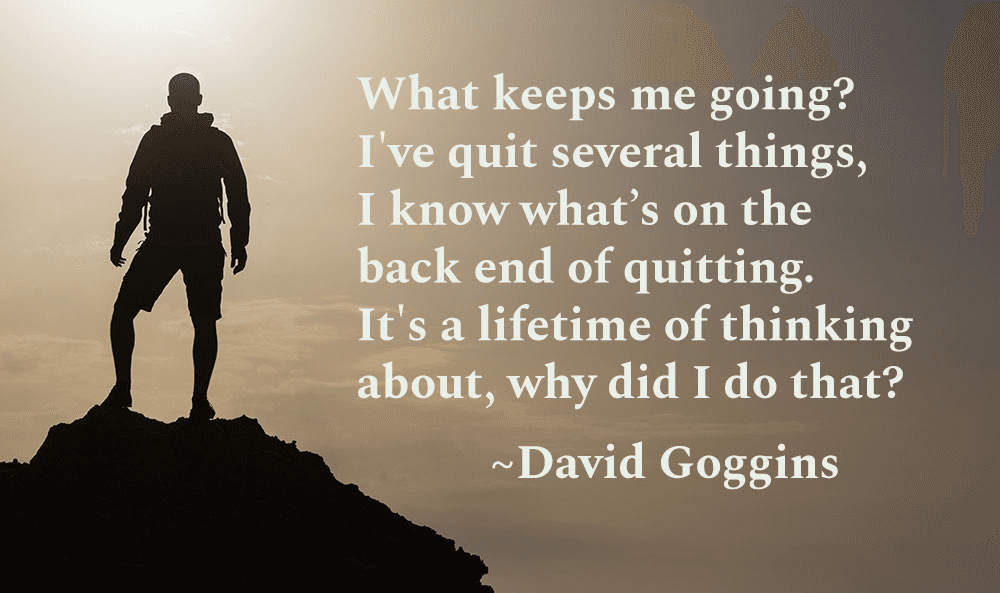
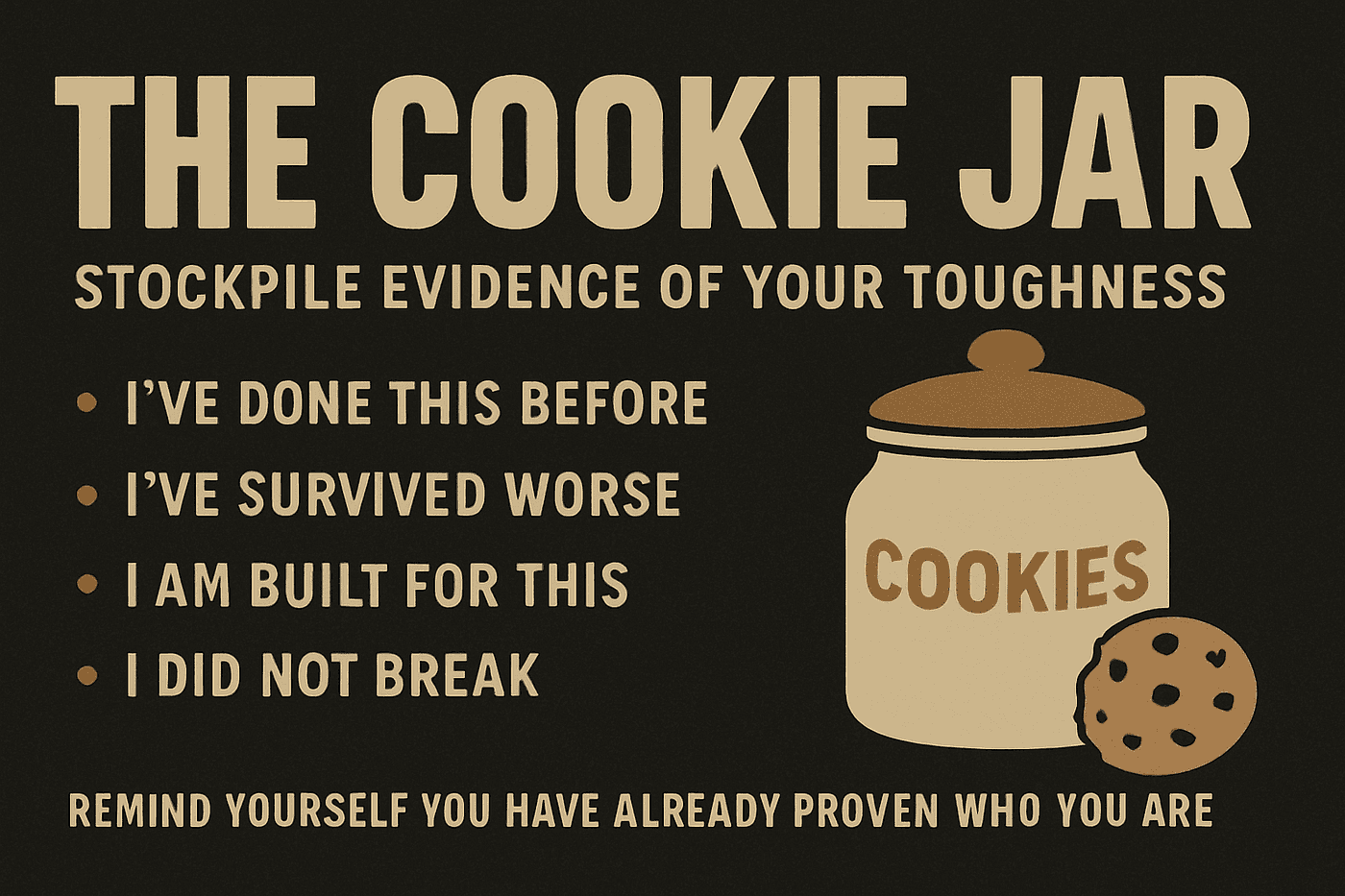
3. The Cookie Jar: Store Evidence That You Can Continue
The Cookie Jar is Goggins’ name for a mental collection of past victories, hardships survived, and moments when he exceeded his own expectations. When a current challenge makes him feel empty, he reaches into that collection for evidence. The method is more grounded than repeating a generic affirmation because the material is real. You are not insisting that you are unstoppable. You are remembering specific occasions when you continued despite wanting to stop.
This idea is useful because stress narrows memory. On a bad day, the current difficulty can feel like the only relevant fact. A rejected proposal becomes evidence that you never succeed. A failed workout becomes proof that you are no longer disciplined. A low exam result appears to erase every subject you have learned before. The Cookie Jar restores context. It says: this moment is difficult, but it is not the complete record of what I can do.
A practical Cookie Jar could be a note on your phone containing ten pieces of evidence: a hard conversation you finally had, a period of grief you survived, a debt you paid down, a skill you learned from zero, a day you kept a promise despite low motivation, or a previous failure that led to a better attempt. Keep the items concrete. “I am strong” is easy for a discouraged mind to reject. “I studied for that certification after work for four months and passed on my second attempt” is evidence.
The Cookie Jar is not nostalgia and should not become an excuse to live on old achievements. Its purpose is to finance the next effort. You withdraw confidence from the past and invest it in a present action. That makes it one of the book’s gentler ideas, even if Goggins often uses it in punishing situations.
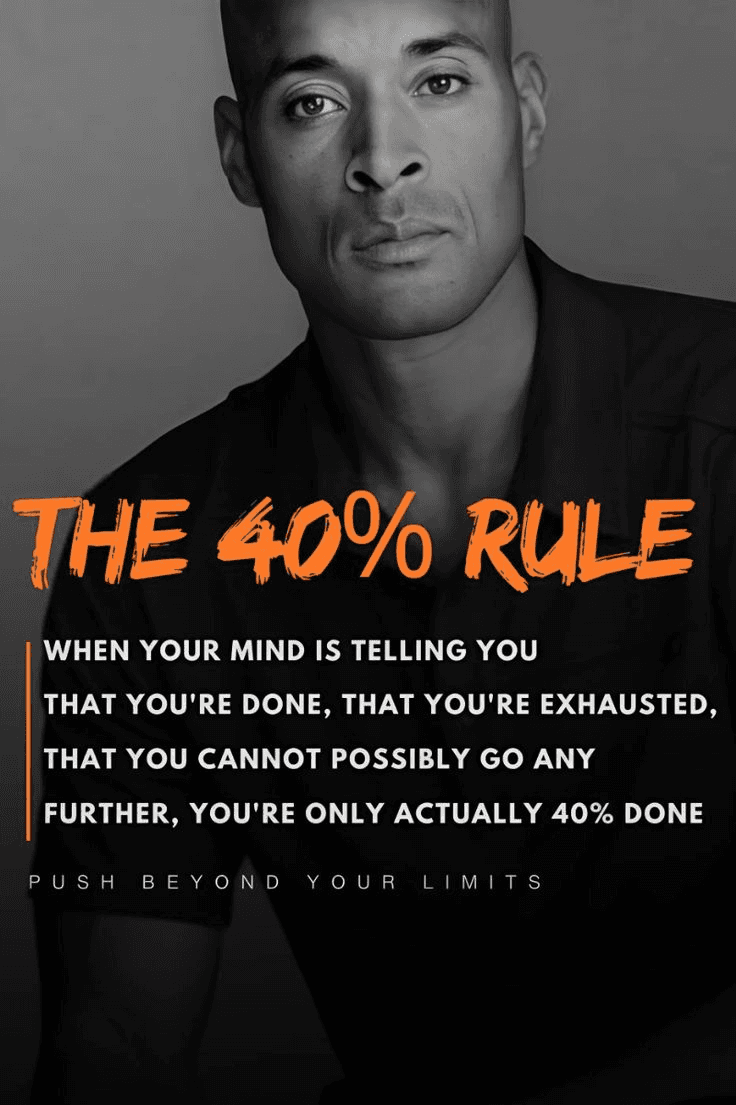
4. The 40% Rule: Your First Limit May Be a Negotiation
The 40% Rule is the concept most closely associated with Goggins. On his official book page, it is presented as the belief that people often tap only about 40 percent of their capabilities. The productive way to understand this is as a motivational rule, not a laboratory measurement that proves every human always has exactly 60 percent left. There is no reason to treat the number as a universal physiological fact.
The metaphor is still powerful. Our first urge to stop frequently reflects discomfort rather than true inability. The first draft feels terrible, so we assume the idea is bad. A workout becomes unpleasant, so we assume the useful portion is over. We receive one refusal and interpret it as the market’s permanent decision. We struggle with a skill in public and conclude that we lack talent. In these situations, the mind may be protecting comfort, status, or certainty—not identifying an actual limit.
The rule works when it creates a second question: “Am I truly unable to continue, or have I reached the point where continuing is no longer pleasant?” That pause can produce another focused twenty minutes, another careful attempt, or a better conversation. It can expose how often we confuse an emotion with an instruction.
It becomes dangerous when applied without context. Pain can indicate injury. Exhaustion can impair driving, judgment, and health. A person in an abusive environment does not need to prove toughness by staying. Someone with a medical condition should not let a motivational slogan overrule professional guidance. The intelligent version of the 40% Rule is not “all limits are imaginary.” It is “some limits deserve to be tested before they are obeyed.”
5. Remove the Governor: Notice the Mechanism That Keeps You Small
Goggins uses the image of a governor—a device that restricts an engine—to describe the mind’s tendency to reduce effort before catastrophe. In ordinary life, a psychological governor can be fear of embarrassment, an identity built around being “not athletic,” a family expectation, perfectionism, or the desire to avoid discovering how much work a goal actually requires.
Removing the governor does not require one huge act. It often means gathering contrary evidence. The person who claims they cannot wake early tries it twice a week. The person who believes they are bad with money tracks spending for one month. The aspiring creator who fears criticism publishes something small. Each action adjusts the boundary of what feels normal.
This is one place where the book can save readers money as well as time. Many purchases are attempts to avoid the emotional cost of beginning. New running shoes, a premium notebook, a complicated productivity subscription, or another online course may feel like movement while leaving the governor untouched. If the real problem is fear of being a beginner, better equipment will not solve it. Goggins’ philosophy encourages a useful buying question: do I lack a tool, or am I hoping the tool will perform the uncomfortable behavior for me?
That question fits the WorthTheCart? approach unusually well. A product is worth buying when it removes a genuine obstacle or improves repeated use. It is not worth buying when it decorates an intention you refuse to practice. Sometimes the strongest purchase decision is to use what you already own for seven days and see whether commitment—not equipment—was the missing feature.
6. Taking Souls: Let Effort Change the Emotional Balance
“Taking Souls” is one of the book’s most aggressive phrases and one of the easiest to misunderstand. In context, it refers to responding to pressure or underestimated ability with such sustained effort that the person imposing the challenge becomes psychologically affected by your refusal to break. It is not a recommendation to harm people. It is a competitive mindset: do not merely survive someone else’s expectation; become so composed and relentless that the expectation loses power over you.
Outside military training or endurance competition, the concept is best translated into quiet professionalism. Imagine being given a difficult project by someone who assumes you will complain. Taking Souls does not require a theatrical confrontation. It might mean asking precise questions, doing excellent work, meeting the deadline, and remaining calm. Your discipline changes the emotional balance because you refuse to behave like the defeated person others anticipated.
There is a risk here. If every task becomes a battle against an enemy, work and relationships can become exhausting. Not every manager, coach, colleague, or family member is an opponent whose spirit needs to be broken. The durable lesson is to convert doubt into concentration instead of resentment. Let underestimated ability sharpen execution; do not let it turn your entire life into revenge.
7. Become Uncommon Among the Uncommon
Goggins does not stop after reaching a level that appears exceptional to most people. He searches for environments where high performance is normal and then asks what separates the strongest people within that group. This idea—becoming uncommon among the uncommon—attacks the temptation to relax as soon as outside praise arrives.
That can be motivating for ambitious readers. The standard around you influences what feels impressive. If everyone in a group avoids effort, moderate consistency may attract praise long before it reaches your actual capacity. Entering a more demanding environment can reset your expectations and expose skills you did not know you lacked.
Yet comparison requires care. Chasing status among increasingly extreme people can become an endless treadmill. There will always be someone faster, richer, stronger, or more productive. The healthiest application is not to make self-worth dependent on winning every room. It is to select a demanding standard in an area that genuinely matters and continue learning after basic competence has made you comfortable.
For a writer, uncommon might mean revising beyond “good enough.” For a manager, it could mean giving difficult feedback clearly and humanely rather than hiding behind process. For someone rebuilding health, it may mean becoming remarkably consistent with a modest plan rather than attempting the most dramatic plan online. Excellence should serve a purpose, not merely feed an identity.
8. Use Failure as an After-Action Report
One of the book’s most practical ideas is to examine failure rather than merely suffer it. Goggins advocates reviewing what happened, identifying weaknesses, and determining what should change before the next attempt. This resembles an after-action review: what was the plan, what actually occurred, why did the gap appear, and what will be different next time?
The method matters because failure often produces one of two unhelpful reactions. We protect the ego by blaming everything outside our control, or we attack our identity with a global conclusion such as “I am useless.” Neither reaction improves the next attempt. An after-action review separates the person from the process. You may have prepared badly without being incapable. You may also face a real external disadvantage without being powerless to adjust.
A good review is specific. “I lacked discipline” is too broad. “I scheduled deep work after three hours of meetings, kept notifications on, and had not defined the first step” gives you something to redesign. The next experiment might move the session to morning, put the phone in another room, and begin with a written task. This lesson may lack the drama of an ultramarathon, but it is one of the clearest ways the book can improve normal work.
Why Can’t Hurt Me Is So Motivating
Many books are pleasant while you are reading them and nearly invisible a week later. Can’t Hurt Me is difficult to forget because it makes its point through contrast. The scale of Goggins’ starting disadvantages and later achievements creates an uncomfortable reference point. Your own task may still be legitimately hard, but it becomes more difficult to call ordinary inconvenience impossible.
The book also treats motivation as unreliable. This is valuable because readers often search for an emotional state that will make action easy. Goggins does not promise that state. He repeatedly acts while afraid, tired, uncertain, embarrassed, or unenthusiastic. The message is not that motivation never matters; a powerful reason can start change. The message is that discipline has to carry the work after emotion stops cooperating.
I find that argument more useful than cheerful encouragement. “Believe in yourself” can fail precisely when belief is absent. “Complete the next promised action even while doubt is present” gives you something to do. Action then creates evidence, evidence changes identity, and identity makes future action more believable. The process is less glamorous than waiting for a breakthrough, but it is far more dependable.
Another reason the book works is that Goggins’ voice does not sound carefully sanitized by a corporate leadership seminar. It is angry, profane, intense, and sometimes uncomfortable. That style will repel some readers, but it gives the message urgency. He does not appear interested in helping the reader feel productive for having purchased a book. He wants the reader to identify a neglected challenge and begin.
The Book Is More Than “Work Harder”
A superficial reading reduces Goggins to a man shouting that everyone should work harder. There is plenty of that energy, but the book contains a more interesting psychological pattern. Goggins first exposes a false identity, then creates a specific challenge, tolerates the discomfort of acting against the old identity, stores the achievement as evidence, and raises the standard. His life changes through repeated identity violations: he does something the previous version of himself believed “people like me” could not do.
That is why the story can resonate beyond fitness. Someone may identify as a person who never finishes books, cannot speak in groups, always mismanages money, or has no creative ability. Arguing with the identity in your head can become an endless debate. Completing a small contradictory action is harder to dismiss. Ten pages a day, one question in a meeting, an automatic savings transfer, or twenty minutes of deliberate practice begins to create a new record.
The book’s real enemy is not weakness but avoidance protected by narrative. Goggins does not deny the reality of what happened to him. He refuses to give the past unlimited authority over what happens next. That balance is important. Personal responsibility should not be used to pretend that abuse, discrimination, illness, poverty, or unequal opportunity are imaginary. It should identify whatever portion of the next decision remains yours.
This is where I think the subtitle, Master Your Mind and Defy the Odds, earns its place. “Master” does not mean eliminate fear, pain, or doubt. Goggins continues to experience them. It means becoming less obedient to the first defensive message the mind produces. The odds may remain unfair; mastery concerns how much of your response you are willing to train.
What I Like Most About Can’t Hurt Me
The strongest feature is its refusal to make transformation look tidy. Goggins does not offer a morning routine that supposedly solves ambition in five steps. He shows that meaningful change can involve relapse, failure, embarrassment, obsession, sacrifice, and the discovery that one success has not repaired everything. That is less marketable than a simple formula and more believable.
I also like that the book creates action without requiring expensive tools. You need no membership, app, supplement, or specialized equipment to tell yourself the truth, write down a weakness, remember a previous victory, or review a failed attempt. In a self-improvement market full of objects that promise to manufacture discipline, that simplicity is refreshing. The hidden ownership cost is emotional rather than financial: the ideas demand that you stop protecting explanations that have made inaction comfortable.
The named mental tools are another strength. “Cookie Jar” is more memorable than “retrieve autobiographical evidence of resilience.” “Accountability Mirror” is more visual than “perform an honest self-assessment.” Goggins understands, intentionally or not, that an idea must be available in the moment of resistance. A concept you cannot recall when tired is not a useful concept.
Finally, the book can expand a reader’s sense of possibility without requiring a literal copy of the author’s life. No, most people will not become Navy SEALs or elite endurance athletes. That is beside the point. If a reader moves from avoiding all discomfort to deliberately completing one meaningful hard thing each day, the change may alter a career, health trajectory, bank account, or relationship. Extreme examples can illuminate moderate decisions.
What I Did Not Like—and What Readers Should Treat Carefully
An honest Cant Hurt Me review needs to say that the book’s greatest strength is also its main weakness. Goggins’ extremity makes the message unforgettable, but it can blur the line between expanding a limit and ignoring a legitimate warning. The narrative contains episodes of extraordinary physical suffering and persistence. Admiring the mental resolve does not require treating every decision as a safe template.
Readers should distinguish discomfort from damage. Discomfort includes boredom, self-consciousness, ordinary muscle fatigue, frustration, fear of rejection, and the urge to procrastinate. Damage may include acute injury, dangerous exhaustion, a worsening medical condition, or psychological distress that requires qualified support. A slogan cannot reliably diagnose the difference. Training intelligently, sleeping, recovering, seeking treatment, and changing a plan are not moral failures. Sometimes stopping is avoidance; sometimes stopping is the decision that makes long-term consistency possible.
The individual-responsibility message can also feel too total. Goggins’ insistence on owning the next action is useful, but readers live inside different bodies, obligations, resources, and constraints. A parent caring for a child, a worker holding multiple jobs, and an athlete with full control over a training schedule do not have the same available time. Discipline remains valuable, but a fair plan begins with reality. The goal should be to use agency, not to feel guilty for lacking someone else’s circumstances.
The prose and structure may divide readers as well. The voice is forceful and often profane. Certain ideas and patterns repeat because Goggins repeatedly tests them in different settings. Readers who enjoy a calm, research-heavy, carefully qualified self-development book may find the presentation exhausting. This is a lived philosophy delivered through memoir, not an academic review of motivation science.
The 40% Rule needs particular caution. It is a vivid heuristic, not a verified universal percentage. Treating it as literal science weakens an otherwise helpful idea. You may have more capacity than your first impulse suggests, but you are not obligated to prove that by overriding every signal. The question is whether a limit should be investigated—not automatically destroyed.
Finally, the book deals with child abuse, racism, trauma, depression, severe physical pain, and graphic hardship. Some readers will find those passages disturbing. The difficult material gives the transformation context, but it is worth knowing that Can’t Hurt Me is not light motivational reading.
Original Edition, Clean Edition, Print, Kindle, or Audiobook?
The best format depends on how you absorb intense material. Print and Kindle make it easier to pause, underline a concept, complete the chapter challenges, and return to specific tools. The hardcover listing identifies a 364-page English edition, although page counts vary slightly between formats. If you want to use the book rather than simply experience the story, a format that allows notes is helpful.
The original edition contains frequent strong language. Goggins’ official book page confirms that a curse-word-free edition is also available. That clean edition is the sensible choice for a younger reader, a shared household, a classroom context, or anyone who finds profanity distracting. Be careful when ordering because the covers and listings can appear similar; check that the product description explicitly identifies the edition you want.
The audiobook is unusually attractive. Audible lists it as narrated by David Goggins and Adam Skolnick with a running time of about 13 hours and 37 minutes. Its podcast-style conversations add commentary between sections, giving listeners more context than a straightforward reading of the printed text. Goggins’ own voice also supplies an intensity that naturally suits the material. For many readers, this may be the most emotionally powerful version.
There is one trade-off: an audiobook can turn challenges into passive entertainment. You may feel energized during a drive and do nothing when the chapter ends. If you choose audio, keep a note open and write one action before starting the next section. The extra step converts inspiration into evidence. A strong approach is to use the audiobook for the story and keep either the ebook or a notebook available for the exercises.
Who Should Read Can’t Hurt Me?
This book is best for someone who knows what they want but has become skilled at postponing it. It suits readers who respond to directness, enjoy memoirs of extreme achievement, and want a practical vocabulary for discipline. It can be particularly effective during a transition: returning to exercise, preparing for a demanding exam, rebuilding after a setback, starting a business, applying for difficult opportunities, or trying to finish a long project.
Athletes and military readers will recognize much of the performance context, but they do not own the lessons. A student can use the Accountability Mirror to confront inconsistent preparation. A creator can use mental callousing to publish work before it feels safe. A job seeker can use the Cookie Jar after rejection. A person changing spending habits can treat a budget review as honest evidence rather than a moral judgment. The arenas differ; the pattern of resistance is similar.
The book also suits readers who have consumed gentler self-help without acting. Sometimes the missing ingredient is not another elegant system. It is enough emotional friction to make the cost of staying the same feel real. Goggins provides that friction in abundance.
If you are building a broader personal-development reading list, WorthTheCart?’s guide to 25 books that could change your life, money habits, and mindset can help you place Can’t Hurt Me beside books with different strengths. Goggins is excellent for intensity and disciplined action; another title may offer more detail on habits, finance, relationships, or reflective psychology.
Who May Want to Skip It?
Skip or postpone Can’t Hurt Me if aggressive motivation reliably makes you feel worse without helping you act. Some people become focused when challenged; others become overwhelmed or spiral into shame. A book is a tool, and choosing the tool that works with your psychology is more intelligent than forcing yourself to admire the loudest one.
Readers seeking peer-reviewed explanations of behavior, a gentle trauma-recovery guide, or a medically informed exercise program should choose a book designed for those purposes. Goggins’ memoir can inspire change, but it is not a substitute for therapy, coaching, medical treatment, or sport-specific programming. It tells you why he pushed. It does not provide a universally safe prescription for how hard your body should train.
You may also want the clean edition or a different book if profanity seriously interferes with your reading. And if stories of abuse, racism, or intense physical suffering are likely to be destabilizing, review the content themes before starting. The book’s rawness is not a small side feature; it is central to the experience.
A Safe Seven-Day Way to Apply the Book
The worst way to respond to Can’t Hurt Me is to become wildly motivated, design an impossible new life overnight, push until something breaks, and then return to the old routine. A better response is to conduct a short experiment that proves you can act differently without confusing drama with progress.
Day 1: Write the Uncomfortable Truth
Choose one area only. Write what you say you want, what your last two weeks of behavior show, and the smallest honest explanation for the gap. Avoid both excuses and insults. End with one action that can be completed within twenty minutes.
Day 2: Build a Real Cookie Jar
List ten specific moments when you handled difficulty, learned something slowly, recovered from failure, or kept a promise. Add dates or details if possible. Put the list where you can reach it before your chosen hard task.
Day 3: Select Useful Discomfort
Do one safe action you have avoided because it feels awkward: send the email, make the call, begin the application, walk into the gym, ask the question, or open the document. The goal is not to feel fearless. The goal is to make fear irrelevant for one action.
Day 4: Test the First Stop Signal
When you want to quit a safe task, continue for a small predetermined amount—perhaps five minutes or one additional problem. Do not use this exercise with injury, dangerous fatigue, or medical symptoms. You are testing ordinary resistance, not gambling with health.
Day 5: Remove One Purchasing Excuse
Identify something you think you must buy before beginning. Use what you already have for one session. If the missing tool genuinely limits you, the test will clarify why. If the work remains possible, you may have avoided an unnecessary purchase and exposed the real obstacle.
Day 6: Enter a Stronger Standard
Find one example of excellent work in your chosen area. Compare process, not self-worth. What does that person or team do consistently that you currently leave to chance? Choose one behavior to copy for a week.
Day 7: Conduct an After-Action Review
Ask what you planned, what you completed, where resistance appeared, and what adjustment would make the next seven days more reliable. Keep any habit that created evidence. Remove any dramatic rule that mainly created exhaustion or guilt.
This plan is deliberately ordinary. That is its advantage. Mental toughness becomes useful when it survives contact with workdays, family obligations, and imperfect energy—not when it exists only during a burst of weekend inspiration.
Does the Book Provide Long-Term Value?
The long-term value of Can’t Hurt Me depends less on how emotional you feel while reading and more on whether you retain two or three tools. If the Accountability Mirror becomes a weekly review, the Cookie Jar changes how you respond to setbacks, or the after-action process turns failure into adjustment, the book can remain useful for years. If it becomes one more intense story consumed and forgotten, the return is mostly entertainment.
This makes the book a good candidate for rereading selectively. You may not need to repeat all 364 pages. Mark the chapter or concept that matches your most common failure pattern. Return to it when that pattern appears. Someone who lies to themselves about consistency needs the Accountability Mirror. Someone who collapses after rejection needs the Cookie Jar. Someone who stops when work becomes dull needs mental callousing. The best lesson is the one you will use at the exact moment your old behavior begins negotiating.
From a cost-per-use perspective, a book does not have to transform your entire personality to be worthwhile. Suppose one idea helps you finish a certification, avoid buying equipment you did not need, submit a better application, or maintain a useful habit for a year. The financial or practical value of that result can easily exceed the purchase price. The calculation is not guaranteed, but it explains why implementation matters more than collecting highlights.
There is also value in disagreement. You do not need to accept Goggins’ complete worldview for the book to expose where your own philosophy is too comfortable. A good book can function as a demanding training partner: not always correct for your body or circumstances, but strong enough to make you defend your standards honestly.
Can’t Hurt Me vs. Never Finished
Readers often ask which David Goggins book to start with. Can’t Hurt Me is the natural first choice because it establishes his childhood, transformation, military experiences, endurance career, and core mental tools. It explains the origin of the public figure and gives the emotional background necessary to understand the philosophy.
Never Finished continues the discussion with later experiences and a deeper emphasis on the ongoing work of the mind. Goggins’ official site describes Can’t Hurt Me as an introduction to the power of the mind and presents the later book as a continuation rather than a replacement. You can read Never Finished alone, but the progression is clearer if you begin here.
If you plan to buy only one, choose Can’t Hurt Me for the more complete origin story and its combination of memoir and memorable beginner concepts. Choose Never Finished later if the first book’s style works for you and you want a second, more developed challenge. Do not buy both merely because inspiration feels exciting in the moment. Finish one, apply a lesson, and then decide whether the sequel addresses a real need.
Final Verdict: Should You Read Can’t Hurt Me?
Can’t Hurt Me: Master Your Mind and Defy the Odds is one of the strongest modern motivational memoirs for readers who need action more than reassurance. It tells a remarkable story, but its lasting value comes from the uncomfortable mirror it holds up to normal life. You may not share Goggins’ ambitions, history, or tolerance for pain. You probably do share the human tendency to stop early, defend familiar habits, and mistake the first wave of discomfort for a command.
My verdict is yes: Can’t Hurt Me is worth reading. It is especially worth reading if you feel stuck in a cycle of knowing, planning, and postponing. The book can remind you that confidence is often built after action, that past hardship can become evidence rather than only weight, and that a failed attempt contains information for the next one. Its best ideas are free to practice and useful far beyond physical training.
Read it with judgment. Do not copy dangerous physical decisions, treat the 40% figure as settled science, or assume recovery is weakness. Use Goggins’ extremes to question your comfortable limits, then build a plan suitable for your actual health, responsibilities, and goals. The strongest reader is not the one who imitates the author most dramatically. It is the one who translates the message into a sustainable change.
For readers who respond well to direct language and intense stories, the original Can’t Hurt Me by David Goggins is the fullest experience. Choose the clean edition if profanity will distract you, and consider the audiobook if hearing Goggins’ voice and the added conversations will keep you engaged. Whichever version you choose, do not let finishing the book become the accomplishment. Pick one avoided action and let that be the first piece of evidence that the old version of you no longer makes every decision.
FAQ
What is Can’t Hurt Me by David Goggins about?
Can’t Hurt Me is a memoir and mental-toughness book about David Goggins’ journey from a childhood marked by poverty, abuse, prejudice, and fear to military service and elite endurance competition. It also teaches practical concepts such as the Accountability Mirror, mental callousing, the Cookie Jar, the 40% Rule, and after-action reviews.
Is Can’t Hurt Me worth reading?
Yes, especially for readers who feel stuck, struggle with consistency, or want a forceful book about discipline and personal responsibility. It is less suitable for people seeking gentle encouragement, academic psychology, or medically specific fitness advice.
Is the 40% Rule scientifically proven?
The exact 40 percent figure should be treated as Goggins’ motivational heuristic rather than a scientifically established universal measurement. The useful principle is that the first desire to stop may reflect discomfort rather than true incapacity. Health, safety, and medical limits still matter.
Is Can’t Hurt Me a self-help book or a memoir?
It is both. The main narrative is autobiographical, but chapters connect Goggins’ experiences to challenges and tools readers can apply to their own goals. Readers who normally dislike abstract self-help may appreciate the story-driven structure.
Is Can’t Hurt Me appropriate for teenagers?
That depends on the reader’s maturity. The book discusses abuse, racism, trauma, depression, profanity, and severe physical suffering. A curse-word-free clean edition is available, but removing profanity does not remove the difficult subject matter. Parents or educators should review the themes before recommending it.
Should I choose the book or audiobook?
Choose print or Kindle if you want to highlight ideas and complete the exercises carefully. Choose the audiobook if you value emotional delivery and extra podcast-style discussion from David Goggins and Adam Skolnick. The audiobook is approximately 13 hours and 37 minutes, so it is also a substantial version rather than a brief summary.
Should I read Can’t Hurt Me before Never Finished?
Yes. Can’t Hurt Me establishes Goggins’ background and core concepts, making it the clearer starting point. Never Finished works best as a continuation for readers who already connect with his style and want to go deeper.
Popular Posts
Personal Finance
Do The Richest Man in Babylon’s Lessons Still Work Today?
Fitness & Gym Equipment
Ekkovision EKKO Lifting Straps Review: The Most Science-Based Lifting Strap?
Gaming & Technology
USB vs PCIe WiFi Adapter: Which Is Better for Gaming?
Books
25 Books That Could Change Your Life: Money, Habits, and Mindset
Keep reading
Related articles
Books & Personal Development