Technology & Consumer Awareness
The $500 Gadget Graveyard: What Happens When a Product’s App Disappears?
A smart gadget can become useless long before its hardware breaks. This article explores what happens when manufacturers shut down apps and cloud services, using real examples such as Humane Ai Pin, Amazon Halo, Dropcam, Nest Secure, Moxie, and Spotify Car Thing—and explains how consumers can protect their devices, data, and money.
By Worth the cart
•
•
3 min read


A connected gadget does not always stop working because its battery dies, its screen breaks, or its internal components wear out. Sometimes the hardware remains in perfect condition while the company behind it closes an app, switches off a server, removes account access, or abandons the software that made the product useful.
The device may still charge. Its lights may still turn on. Its sensors, microphones, cameras, buttons, and wireless chips may all function exactly as designed. Yet without the company’s app or cloud platform, the product can become little more than an expensive object occupying space in a drawer.
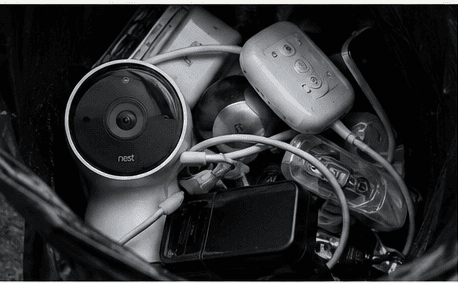
This is the modern gadget graveyard: a growing collection of smart cameras, fitness trackers, wearables, home-security products, speakers, children’s robots, weather stations, connected appliances, pet devices, and experimental AI hardware that became obsolete before the physical product actually failed.
The central problem is easy to overlook when shopping. A connected product appears to be a physical object that you purchase and own, but many modern gadgets are really two products combined. The first is the hardware sitting in your home. The second is an invisible network of apps, cloud servers, accounts, subscriptions, security certificates, databases, software updates, and third-party services controlled by the manufacturer.
You may own the first half. The company continues to control the second.
When that company changes direction, runs out of money, sells the technology, replaces the app, or decides that supporting the product is no longer profitable, the owner can lose access to both halves.
Software-dependent obsolescence is the loss of a product’s practical usefulness because its app, cloud platform, account system, or supporting software is withdrawn—even though the physical hardware may still be functional.
That definition matters because software-dependent obsolescence is different from ordinary wear. A broken battery can sometimes be replaced. A damaged cable can be swapped. A cracked screen may be repaired. But when a manufacturer closes the authentication server required to activate a product, there may be no component the owner can purchase to bring it back.
The real lifespan of a smart gadget is therefore not determined only by its materials or build quality. It is also determined by how long the manufacturer is willing and able to maintain the digital infrastructure around it.
The Question Buyers Rarely Ask
Most people evaluate a smart device by looking at its current features.
How accurate are the sensors? How long does the battery last? How clear is the camera? Does the app look easy to use? Can the device connect to Alexa, Google Home, Apple Health, or another platform? Is the product receiving good reviews?
These are reasonable questions, but they all assume the service will continue operating.
A more important long-term question is rarely addressed:
What will this product still do if the manufacturer’s app or cloud service disappears?
For some products, the answer may be reassuring. A connected light bulb might still operate through a normal wall switch. A smart lock may still open with a key or keypad. A camera may continue recording to a local memory card. A speaker might retain basic Bluetooth playback even if its online integrations disappear.
For other products, almost nothing remains.
A fitness wearable may collect data that can no longer be viewed. A camera may lose recording, notifications, remote access, and even initial setup. An AI device may become unable to answer questions because every response was generated on remote servers. A social robot may retain its motors and speakers while losing the personality and conversations that defined the product.
This risk is difficult for buyers to evaluate because manufacturers frequently fail to publish a clear software-support period. A Federal Trade Commission staff review examined 184 connected products, including cameras, locks, hearing aids, and other smart devices. Nearly 89% did not clearly state on their product webpages how long software updates would be provided. Even after broader online searches, the FTC could not locate support-duration information for 124 of the products examined.
That means a customer may receive detailed information about dimensions, colours, battery capacity, compatibility, warranties, and shipping while receiving no clear answer about how long the software-dependent features are expected to survive.
For a conventional product, this omission would seem strange. Imagine buying an appliance without knowing whether the manufacturer expected it to remain functional for two years or ten. Yet buyers routinely spend hundreds of dollars on smart products whose digital lifespans are undefined.
The Invisible Second Half of a Smart Product
A traditional product normally performs its core function inside the object itself. A basic lamp uses electricity to produce light. A mechanical watch tracks time through physical movement. A wired speaker converts an audio signal into sound. These products may eventually fail, but they do not normally require the manufacturer to remain actively involved after the sale.
Connected gadgets work differently.
When a user views a camera remotely, checks sleep data, changes a thermostat from another location, receives a security notification, or asks an AI assistant a question, the request may pass through several systems outside the device. The app verifies the account, communicates with a remote server, retrieves stored information, processes a command, and sends an instruction back to the hardware.
The app is often only the visible entrance to a much larger service.
Behind it may be cloud storage, databases, notification systems, payment processing, analytics tools, mapping services, artificial-intelligence models, video infrastructure, voice processing, third-party integrations, security certificates, and account-authentication services.
The continued operation of the product depends on someone paying for all of that.
Developers must update the app when mobile operating systems change. Security teams must patch vulnerabilities. Servers must be maintained. Customer-support staff must help with logins and setup. Data must be stored and protected. External services may require licensing payments. Even a product that is no longer being manufactured can continue creating operating costs for the company that sold it.
This produces a conflict between the customer’s expectations and the manufacturer’s incentives.
The customer may expect a premium gadget to last for several years because the physical hardware remains useful. The manufacturer may view the same product as a discontinued service that continues consuming money and staff time.
Once the company decides that those costs are no longer justified, the product can reach the end of its useful life on a date chosen in a boardroom rather than through natural wear.
What Actually Happens When an App Disappears?
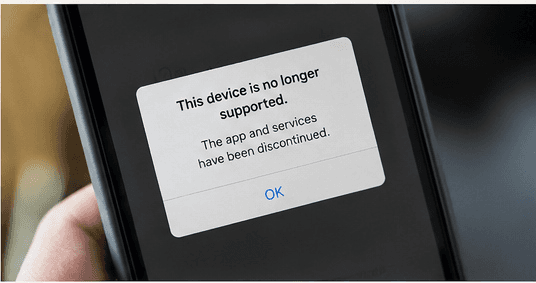
An app disappearing does not always mean it vanishes from the Apple App Store or Google Play overnight. There are several forms of app abandonment, and each creates a different level of damage.
The most severe version occurs when the company shuts down its cloud servers. The app may remain installed on the phone, but it can no longer log in, retrieve information, or communicate with the hardware. Reinstalling an older version will not help because the missing part exists outside the phone.
A second version occurs when the app stops receiving updates. It may continue working for existing owners temporarily, but eventually a new version of iOS or Android can break compatibility. Changing phones, resetting the product, losing login credentials, or accidentally deleting the app may turn an otherwise functioning device into something that cannot be set up again.
Another version appears when the manufacturer forces customers to migrate to a replacement app. The product may technically remain supported, but previously available features, integrations, automations, historical data, or account settings can be lost during the transition.
A fourth version occurs when important features are moved behind a subscription. The app still exists, but the meaning of ownership changes. A customer who originally paid for the hardware may later discover that useful history, remote access, advanced analysis, cloud storage, or notifications now require an ongoing payment.
These outcomes are not equally severe, but they share the same underlying problem: the buyer has limited control over the software required to use the product.
The most resilient connected products treat online services as enhancements. They can lose remote access or advanced analysis while preserving their basic purpose locally.
The most fragile products treat the cloud as a requirement. Without the company’s servers, the device cannot perform the function for which it was purchased.
The Difference Between a Discontinued Product and a Disabled Product
Products are discontinued all the time. A manufacturer stops selling an old laptop, television, camera, or appliance when a newer version becomes available. Discontinuation alone does not normally mean that existing products immediately stop working.
A disabled connected product is different.
When a cloud-dependent product is shut down, the manufacturer may remove abilities that were present when the customer purchased it. The owner is not merely missing future features or optional improvements. They may lose the original product’s central function.
This distinction is important when companies describe shutdowns using phrases such as “ending support,” “retiring the platform,” or “winding down the service.”
Those phrases can refer to very different outcomes.
For one product, ending support may mean that no new features will be added, while the existing device continues working. For another, it may mean the app cannot connect, data becomes inaccessible, and the hardware becomes unusable.
Consumers should therefore look beyond the phrase “end of support” and ask what will happen to each core feature.
Will the device continue operating locally? Can it be controlled manually? Will existing accounts remain accessible? Can historical data be exported? Will subscriptions stop automatically? Can the product be reset and activated again? Will it receive security updates? Can another app or service take over?
The answers determine whether the owner is losing convenience or losing the product itself.
Humane Ai Pin: Hardware With a Fixed Digital Expiration Date
Humane’s Ai Pin became one of the clearest examples of how quickly a cloud-dependent product can lose its value.
The wearable was presented as an alternative approach to personal computing, built around voice commands, messaging, calls, image capture, cloud access, and artificial-intelligence responses. Many of those capabilities depended on Humane’s remote infrastructure rather than being processed entirely on the device.
When Humane decided to wind down the consumer product, the company gave owners a precise deadline. The Ai Pin would continue functioning until noon Pacific Time on February 28, 2025. After that point, it would no longer connect to Humane’s servers. Calling, messaging, AI queries, cloud access, and the company’s online account service would stop. Remaining consumer data would also be permanently deleted, and users were instructed to download stored pictures, videos, and notes before the deadline.
The hardware did not physically expire at noon.
Its practical usefulness ended because the digital system around it was withdrawn.
This is the clearest form of software-dependent obsolescence. The device’s most important abilities were not contained inside the product in a form the owner could continue operating independently. They existed through a service controlled by the manufacturer.
A customer could not solve the problem by replacing the battery, repairing a component, installing a new cable, or visiting a local technician. Even a perfectly preserved Ai Pin could not independently recreate the cloud services required to answer questions and perform its advertised tasks.
The example also reveals why the original purchase price does not fully describe the risk. A customer may spend hundreds of dollars on hardware, pay for service, invest time learning the product, create personal data, and buy accessories. When the platform closes, the loss includes more than the resale value of the device.
It includes the entire system built around it.
Amazon Halo: When the App Was the Product
Amazon Halo illustrates a similar problem in the health and fitness category.
Products such as Halo Band, Halo View, and Halo Rise collected or interpreted information related to activity, sleep, and other health-focused measurements. The physical devices contained sensors, but much of their usefulness came from the Halo app, where users could access and understand the information.
Amazon announced that support for Halo would end on July 31, 2023. From August 1, the devices and the Halo app would stop functioning. Users were advised to download or delete their health data before the service ended, and Amazon said remaining Halo data would later be removed.
Amazon offered refunds for Halo products purchased during the preceding 12 months, refunded unused prepaid subscription fees, stopped future subscription charges, and offered prepaid recycling.
That was a more structured shutdown than some owners of abandoned gadgets have received. However, compensation did not change the basic result: functional sensors and wearable hardware became unusable because the app and platform were discontinued.
Halo demonstrates that data collection alone does not make a health device valuable.
The usefulness comes from the ability to access, interpret, compare, and export that data. When the software disappears, the product may still contain capable sensors, but the owner loses the interface that turns raw measurement into something understandable.
This is why customers should examine data portability before choosing a fitness tracker, smart ring, health monitor, or connected scale.
Can the measurements be exported in a common format? Can they be synchronised with a broader health platform? Does the user retain access if they cancel a subscription? Can the device display useful information without contacting the company’s servers?
A closed dashboard can create convenience while the platform is active, but it can also trap years of personal information inside a system the customer does not control.
Dropcam: A Camera That Could No Longer Be a Camera
Google’s retirement of Dropcam and Dropcam Pro shows how app dependency can affect products purchased for practical home security.
Support ended on April 8, 2024. After the deadline, the cameras could no longer connect to the Nest app, stream video, record footage, provide notifications, or allow users to change settings. Existing video history also became unavailable.
The significant detail is not simply that the cameras stopped receiving new features.
They could no longer perform the central actions people normally expect from a connected security camera.
The lenses, image sensors, Wi-Fi components, housings, and power connections could remain intact. Yet the loss of the supporting service prevented owners from viewing live footage or recording new video through the official system.
For a decorative smart accessory, this would be frustrating. For a security product, the consequences are more serious. People may rely on a camera to monitor a home, check on a pet, observe an entrance, document an incident, or receive alerts while away.
Replacing a cloud-dependent security device can also involve more than buying a new camera. The owner may need to remove mounted hardware, install a new product, change a subscription, rebuild notification settings, reconnect smart-home routines, and learn another platform.
This is one reason local storage matters.
A camera that can record to a memory card, network recorder, or local hub may retain meaningful functionality even if its cloud features disappear. It might lose remote viewing or intelligent alerts, but it does not necessarily lose its ability to capture video.
A cloud-only camera places more control in the hands of the manufacturer. Its convenient features can be excellent while the service is active, but its useful lifespan may be shorter than the physical lifespan of its camera hardware.
Nest Secure: When the Product Protecting the Home Loses Its Connection
Nest Secure presents another version of the same problem.
Google ended support for the alarm system, which stopped connecting to cloud services and became unavailable through the Nest app. Owners could no longer check the system’s status remotely, control connected Nest Secure devices through the app, or receive online alarm notifications. Google also warned that the system would no longer receive software or security updates and advised against continuing to rely on it.
The shutdown also affected the wider system around the product. Some Nest x Yale Lock owners had used Nest Guard as the bridge connecting their lock to Wi-Fi and needed to replace that connection method to preserve online access. The keypad could still operate the lock locally, but app-based access depended on a supported bridge.
This shows why smart-home products should not be evaluated individually.
One discontinued hub can affect several connected products. A security platform may link alarms, locks, sensors, cameras, routines, and subscriptions. When the central service disappears, the owner may need to rebuild an entire part of the home around another ecosystem.
The true replacement cost therefore includes more than the original device.
It may include compatible accessories, professional installation, subscription changes, lost automations, time spent reconfiguring the home, and the disposal of equipment that cannot be reused.
A $200 product can easily create a $500 transition.
What These Shutdowns Have in Common
Humane Ai Pin, Amazon Halo, Dropcam, and Nest Secure were different products made for different purposes. One was an experimental AI wearable. Another was a health platform. The others were home-security products.
Their shutdowns nevertheless reveal the same structural weakness.
The owner possessed the hardware but did not control the system required to keep it useful.
In each case, the manufacturer’s continuing participation was not merely helpful. It was part of the product’s operation. When that participation ended, the hardware lost important or essential abilities.
This does not mean companies can realistically support every product forever. Software systems age. Security standards change. Cloud infrastructure costs money. Products fail commercially. Companies are acquired, reorganised, or closed.
The problem is not that all services eventually end.
The problem is that customers are often asked to purchase connected products without knowing how the ending will be handled.
A responsible connected product should answer three questions before the customer buys it:
How long is software support promised? What will still work when support ends? What happens to the customer’s data?
When a manufacturer cannot provide clear answers, the buyer is accepting an unknown expiration date.
The Product Is Hardware Plus a Promise
A smart product is not simply hardware with extra features.
It is hardware bundled with a promise of continued digital support.
That promise includes maintaining the app, securing the service, operating the cloud platform, preserving account access, supporting changing phone systems, fixing compatibility problems, and protecting stored data.
The promise may not appear clearly on the box, but it influences the product’s real value.
A well-built traditional product can remain useful even if its manufacturer disappears. A well-built connected product may become useless if the manufacturer merely loses interest.
This is why build quality alone is not enough to judge modern gadgets.
A premium casing, strong battery, accurate sensor, and polished interface can still produce a poor long-term purchase when the core function depends on a service with no published support period or credible end-of-life plan.
The smartest product is not necessarily the one with the most cloud features.
It may be the one designed to survive after those features are gone.
There Are Different Levels of Gadget Death
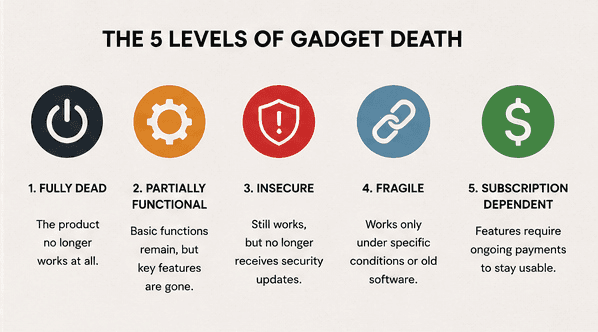
Not every abandoned smart product becomes completely useless in the same way. Some devices stop functioning immediately because every important action depends on a remote server. Others continue operating in a reduced form, losing only the features that once made them “smart.” A third group remains technically functional but becomes increasingly unsafe because security updates have ended. There are also products that survive only as long as the owner avoids resetting them, changing phones, updating an operating system, or deleting an old app.
These differences matter because “support is ending” can describe several very different outcomes.
A fully dead product can no longer perform its main purpose. It may be unable to authenticate an account, complete setup, retrieve data, process commands, or communicate with the company’s infrastructure. The hardware remains present, but there is no meaningful route back into the product.
A partially functional product retains its most basic local abilities. A smart light may still work from the wall switch but lose scheduling, remote control, colour settings, and voice commands. A connected appliance may continue washing clothes or brewing coffee while losing diagnostics, notifications, recipes, or energy monitoring. The owner still has a usable object, but not necessarily the product that was originally advertised.
An insecure product presents a different problem. It may continue working normally while no longer receiving updates for newly discovered vulnerabilities. This is particularly serious for cameras, routers, locks, alarms, children’s devices, health products, and anything that contains a microphone or stores sensitive information. A gadget does not need to stop functioning to become a bad long-term purchase. It may continue operating while becoming less trustworthy every month.
Some devices become trapped in a fragile state. They work only because the owner has the correct app installed on an older phone. A factory reset, lost password, account problem, operating-system update, or replacement handset can break a setup that had appeared stable for years. The product is not truly independent. It is surviving through a chain of old software that can fail at any time.
Finally, some products remain usable but become subscription-dependent. The manufacturer does not shut the device down, yet features that once appeared central to the purchase may gradually move behind a recurring payment. The owner still possesses the hardware, but the product’s full usefulness is rented back to them month by month.
The important question is therefore not simply whether a connected gadget survives.
It is what version of the product survives, how safely it continues operating, and whether that reduced version still justifies the money originally spent.
Moxie: When a Product Shutdown Becomes Emotional
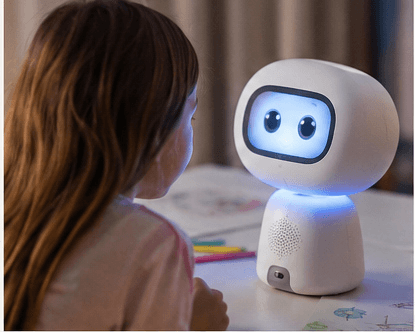
The shutdown of a camera, speaker, or fitness tracker can create financial loss and frustration. The shutdown of a social robot can create something more complicated.
Moxie was designed as an interactive robot for children. It could hold conversations, guide activities, respond to the child, and develop an experience that felt more personal than using a conventional screen or toy. The product was not marketed only as hardware. Its value came from the relationship created through repeated interactions.
When the original company behind Moxie announced that it was closing, it explained that the robot depended on cloud services for its core functionality. Without those services, Moxie could not continue operating normally. The parent app, online resources, warranties, and repair support were also affected.
For the adults who purchased it, the shutdown represented the potential loss of expensive hardware. For some children, it meant that a familiar character could suddenly stop responding.
That distinction is important because technology companies increasingly design products to encourage emotional attachment. Social robots, AI companions, digital pets, conversational toys, and personalised assistants are not presented as neutral tools. They are designed to remember preferences, recognise routines, develop a consistent personality, and create the feeling of an ongoing relationship.
When a company deliberately builds that attachment, it also creates a greater responsibility when the service ends.
A calculator can stop working without requiring an explanation. A social robot that has spent months speaking to a child cannot always disappear without emotional consequences. The ending may need to be explained in language the child understands, and the product may require a form of goodbye rather than a standard discontinuation notice.
Moxie later received the possibility of a second life after rights to the product were acquired by another company working to reactivate eligible units. That outcome is unusual and more positive than permanent shutdown. However, it does not remove the underlying concern. The robot’s continued existence depended on another company choosing to rebuild the service. The physical product remained in customers’ homes while its memory, personality, and usefulness depended on who controlled the servers.
A rescue can restore access.
It cannot turn temporary access into true ownership.
Spotify Car Thing: Useful Hardware That Could Not Continue Officially
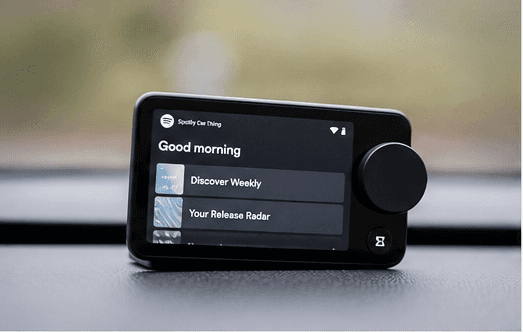
Spotify’s Car Thing was a dedicated controller intended to make Spotify easier to use in a vehicle. It provided a screen, physical controls, voice interaction, and a more focused interface for navigating music and podcasts while driving.
The product was not designed to be a complete entertainment system. It was a specialised companion for a service many owners already used.
Spotify eventually stopped manufacturing Car Thing and later announced that existing devices would become non-operational. The hardware did not gradually wear out. It reached an official end date set by the company.
Car Thing is a useful example because the device contained parts that could still have served another purpose. It had a display, buttons, connectivity, and a form factor some owners liked. Yet the official system did not provide a lasting offline mode or an easy way to repurpose the hardware after support ended.
Technically skilled users began experimenting with unofficial software that could turn Car Thing into a desktop controller or another form of display. This showed that the hardware itself had not become worthless. Its official usefulness had been removed, but its physical components remained capable of doing something.
That difference exposes one of the most wasteful parts of cloud-dependent design.
The company may be finished with the product, but the product is not necessarily finished.
A responsible end-of-life update could potentially remove unnecessary authentication, unlock local controls, publish documentation, or create a limited mode that allows the hardware to continue functioning. Not every product can safely become open-source, and licensing or security restrictions may prevent a complete release. However, the default outcome should not always be a forced journey from desk to drawer to recycling centre.
Community projects can sometimes save abandoned hardware, but they are not an acceptable primary plan for ordinary customers. Most buyers do not know how to install modified firmware, use command-line tools, verify unofficial files, or judge whether a community project is safe.
People should not need software-development skills to continue using a product they purchased normally.
The App Migration Problem
A product does not need to be permanently abandoned for software dependency to create serious problems.
Sometimes the manufacturer is still operating, still supporting the hardware, and genuinely trying to improve the service. The company may replace an older app with a redesigned platform that uses newer security systems, updated infrastructure, and a more modern interface.
In theory, this should be a positive change.
In practice, a forced migration can reveal how much of the product the owner never truly controlled.
Years of historical data may display differently or fail to transfer. Automations can disappear. Integrations may stop working. Account systems may require new passwords, email verification, or subscription terms. Features used by long-term owners may be missing because the new development team considered them less important.
A redesigned app can look cleaner while making the product less useful.
This is common when companies measure success through the needs of new customers rather than the routines of existing ones. New users may prefer a simplified interface, while long-term owners depend on detailed charts, exports, alerts, device grouping, local controls, or advanced settings that are not visually impressive but are central to how the product is used.
Weather stations provide a good illustration. An owner may have spent years building a record of local temperature, rainfall, humidity, wind, and sensor history. Moving that user to a new app is not simply a design update. It is a migration of a personal dataset and a routine that may have existed for much longer than the current software team.
The same applies to smart-home systems. A user may have dozens of devices organised into rooms, schedules, scenes, and automations. A platform migration that forgets those settings creates hours of unpaid work for the customer.
Companies often describe migration problems as temporary inconvenience.
From the owner’s perspective, the app is part of the product. A failed migration is therefore closer to replacing a physical component with something that does not yet perform the same job.
The best migrations run both systems in parallel for a meaningful period, provide clear feature comparisons, preserve historical data, allow users to export information, and avoid forcing customers onto an incomplete replacement.
The worst migrations treat the old app as an obstacle that needs to disappear before the new one is ready.
The Subscription Trap: When the Product Survives but Ownership Changes
Not every connected product enters the gadget graveyard through a complete shutdown. Some remain physically and digitally active while the financial conditions around them change.
A company may sell hardware at a competitive price, attract a large user base, and later move advanced features behind a subscription. Remote access, cloud history, AI analysis, video storage, detailed health insights, location tracking, or automated reports may no longer be included in the original purchase.
The product has not died.
The original idea of ownership has been weakened.
Subscriptions are not automatically unfair. Cloud storage, cellular connectivity, continuous AI processing, professional monitoring, and ongoing development create real costs. A company cannot always provide those services forever from a single hardware payment.
The problem appears when the recurring cost is hidden, introduced after purchase, or attached to features that buyers reasonably believed were part of the hardware.
A camera that requires a subscription for long-term cloud recording is understandable when this is explained clearly before purchase. A camera that later moves basic notifications or previously included history behind a paywall creates a different relationship with the owner.
The same problem appears in fitness products. A customer may buy a wearable because it measures sleep, recovery, stress, or activity. If the device collects those measurements but requires a monthly payment to interpret them, the hardware is only part of the real cost.
A smart ring that costs $300 and requires $6 per month does not cost $300.
After three years, it has cost more than $500 before replacement bands, charging accessories, or future price increases are considered.
This is why buyers should calculate the cost of ownership over several years rather than looking only at the purchase price. A lower-priced gadget with an unavoidable subscription can eventually cost more than a premium alternative that offers local features or includes analysis without recurring fees.
The subscription also creates another form of shutdown risk.
If the company raises the price, removes the lowest plan, limits free features, or changes the subscription structure, the owner must either accept the new terms or use a reduced version of the product.
Ownership becomes conditional.
Can Your Data Leave With You?
When a connected product disappears, the hardware is only one part of what the customer may lose.
A wearable can contain years of sleep history, activity records, heart-rate trends, recovery scores, body measurements, and personal routines. A weather station may hold a detailed record of local conditions. A camera may store security clips and event history. An AI assistant may contain notes, photographs, conversations, or saved preferences.
This data can become more valuable than the device itself.
A gadget may be replaced in a day. Years of personal history cannot always be recreated.
Data portability is the ability to retrieve information from a service in a format that can be saved, read, or transferred elsewhere. It is one of the most important signs of whether a company treats the customer as the owner of their own information.
A downloadable archive is better than a dashboard that exists only inside the app. A spreadsheet is more durable than a graph that disappears with an account. Standard image, video, health, or document formats give the user more protection than proprietary files that require the original service to interpret them.
The worst time to discover that data cannot be exported is after a shutdown announcement.
Companies often give customers a limited period to retrieve information before the service closes. That can create panic, especially when export tools are confusing, incomplete, or unreliable. Users may have only a few weeks to download years of records while support teams are overwhelmed by thousands of similar requests.
A responsible product explains data export before the first year of history is collected.
Buyers should look for clear answers to several questions. Can the data be downloaded? Is the format understandable without the original app? Can it be transferred to another service? Does deleting the account also delete the cloud copy? What happens to the information when a subscription ends?
The ability to leave a platform is one of the strongest forms of consumer protection.
A company that makes departure deliberately difficult may be revealing how dependent it expects the customer to become.
The 24-Hour Offline Test
One of the simplest ways to evaluate a connected gadget is to imagine that the manufacturer’s servers disappear for 24 hours.
Not your home Wi-Fi.
Not your phone.
The company itself.
What can the product still do?
Can the security camera record locally? Can the light operate through a physical switch? Can the thermostat maintain its schedule? Can the lock be opened without an account? Can the robot vacuum start from a button? Can the speaker work over Bluetooth? Can the appliance perform its basic mechanical function? Can data be accessed directly?
A product that temporarily loses remote access is very different from one that loses its entire purpose.
The offline test does not argue that cloud features are unnecessary. Remote servers can make products more capable, easier to update, and more convenient. They can handle heavy processing, synchronise devices, store backups, provide remote notifications, and deliver features that would be difficult to run locally.
The issue is whether the cloud improves the product or holds it hostage.
A resilient gadget continues performing its basic purpose locally and uses the internet for enhancements. A fragile gadget requires the company’s permission for every meaningful action.
Consider two security cameras. One records to a local memory card while offering optional cloud backup. The other stores everything remotely and requires an active account to view the feed. They may look similar in a product comparison, but they carry completely different long-term risks.
The first camera may lose smart detection or remote history if the service ends, yet still retain basic recording. The second may become an empty lens.
The same principle applies across categories.
A smart lock with a physical key, keypad, and local control has more resilience than a lock whose management depends entirely on remote authentication. A robot vacuum with physical buttons and local mapping is less fragile than one that cannot clean without contacting an account server. A fitness device that displays useful information directly is more independent than one that turns every sensor reading into inaccessible data without the app.
The 24-hour offline test is not perfect, but it reveals where the intelligence actually lives.
Open Standards Versus Proprietary Islands
One reason some products survive longer than others is that they use standards supported by multiple manufacturers and platforms.
A standard Bluetooth speaker can usually connect to a new phone even if the manufacturer’s companion app disappears. A storage device using common file formats can be read by many computers. A camera supporting established local protocols may be usable with third-party software.
A proprietary product can create a smoother experience while the original ecosystem is healthy. Setup may be simpler, design may be more consistent, and features may work together beautifully.
The risk is that one company controls every door into the system.
Proprietary connectors, file formats, account requirements, communication protocols, and cloud services can make switching platforms difficult or impossible. When support ends, no competitor can easily take over because the product was never designed to speak to anything else.
Open standards do not guarantee immortality. Technology changes, and community support can also disappear. However, standards create more possible paths forward. They allow third-party apps, replacement services, local control, and broader compatibility.
This is especially important for products built into the home. A phone or wearable may be replaced every few years. Lighting, locks, thermostats, appliances, cameras, and mounted sensors may remain installed for much longer.
The longer the expected physical lifespan, the more dangerous exclusive dependence on a proprietary platform becomes.
A connected oven should not become obsolete on the same schedule as a phone app.
A Large Company Is Not a Lifetime Guarantee
Customers often assume that buying from a large technology company protects them from shutdown risk.
The assumption is understandable. Large companies have more money, larger engineering teams, established support systems, and stronger infrastructure. They may be more capable of providing refunds, replacement offers, long migration periods, and responsible recycling.
They also discontinue products.
Amazon ended Halo. Google ended support for Dropcam and Nest Secure. Spotify disabled Car Thing. These companies did not collapse. They decided that the products no longer justified continued investment.
A startup and a large technology company create different risks.
A startup may fail because it runs out of money, cannot raise another investment round, loses a supplier, or never reaches enough customers to support its cloud costs. The product may disappear because the company itself disappears.
A large company may continue thriving while abandoning a product that does not meet internal targets. The product can be technically successful and loved by a smaller audience but still fail to fit the company’s broader strategy.
The startup creates financial risk.
The technology giant creates strategic risk.
Company size should therefore be only one part of the buying decision. More useful questions concern the design of the product itself. Can it operate locally? Does it use common standards? Can data be exported? Has the company published a support period? Is there a clear end-of-life policy? Does the hardware have a useful mode that survives without the service?
The safest product is not always sold by the largest company.
It is the product that needs the company least.
What a Responsible Shutdown Should Look Like

No company can guarantee that every digital service will remain available forever. Products age, security standards change, server costs continue, companies fail, and technology moves on.
The goal should not be permanent support for every gadget ever sold.
The goal should be a fair and predictable ending.
A responsible shutdown begins with meaningful notice. Customers need enough time to understand what is happening, export data, find replacements, cancel subscriptions, and make changes to important systems such as cameras, alarms, locks, and health devices.
The announcement should explain exactly what will stop working. “Support is ending” is too vague when the outcome can range from losing future updates to losing the entire product. Owners need a feature-by-feature explanation of what remains available.
Refunds and replacement offers should reflect the price, age, and reasonable expected life of the product. Someone who bought a device shortly before the shutdown should not be protected only if they happen to remain inside a narrow return window.
The final software update should preserve as much local functionality as possible. Account checks can sometimes be removed. Basic controls can be unlocked. Documentation can be published. Local modes can be enabled. Authentication servers can potentially be replaced with offline activation.
When safe and legally possible, the company should consider allowing community developers to maintain abandoned hardware. This may involve releasing selected code, communication protocols, development tools, or documentation rather than making the entire product open-source.
Data export should be simple, complete, and available well before the shutdown deadline. Subscription charges should stop automatically. Customers should not need to contact support repeatedly to prevent future billing for a service the company is closing.
Recycling should be the final option, not the first.
A company that designed hardware to depend completely on its service shares responsibility for the waste created when that service disappears.
Governments Are Beginning to Notice
Regulators are slowly paying more attention to the support period of connected products.
The central concern is usually security. A device that remains connected to the internet without receiving updates can become vulnerable, even if it appears to work normally. This is especially serious when the product handles video, audio, location, health information, or access to a home.
Some newer rules require manufacturers to provide clearer information about how long security updates will be available. This is an important improvement because buyers cannot judge the long-term safety of a connected product without knowing when official protection ends.
However, security support and functional support are not the same.
A company may promise several years of vulnerability fixes while still changing subscriptions, removing optional services, replacing an app, or eventually retiring the cloud platform. A product can receive its final security update and remain physically intact while losing the online system that gives it meaning.
Future consumer rules may need to address more than cybersecurity. They may need to establish minimum notice periods, data-export requirements, refund expectations, service-continuity disclosures, and end-of-life plans for hardware that becomes unusable when a company-controlled service closes.
One of the most valuable changes would be a simple disclosure placed directly on the product page:
Minimum software support period.
That information should be as easy to find as battery life, storage capacity, warranty length, and dimensions.
Without it, customers are being asked to purchase a product without knowing one of its most important lifespan specifications.
What to Check Before Buying Another Smart Gadget
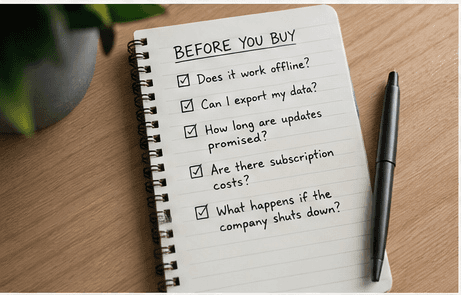
The best time to investigate a future shutdown is before buying the product.
Start by identifying the core function. Ask what the device is fundamentally meant to do, then determine whether that function survives without the manufacturer’s app or servers.
Read the support pages, not only the product description. Marketing pages focus on what a gadget can do today. Support documents are more likely to reveal account requirements, subscriptions, export options, offline limitations, and what happens when services change.
Search for a published update period. When the company does not provide one, consider contacting support before buying. The response may reveal how seriously the manufacturer thinks about long-term ownership.
Look for local controls. Physical buttons, standard remotes, memory-card storage, local network access, Bluetooth modes, manual keys, and direct data export may appear less impressive than cloud features, but they often extend the useful life of the product.
Check whether the product uses common standards or only a closed platform. The more exclusive the ecosystem, the fewer alternatives will exist if the company leaves the category.
Investigate subscriptions from the beginning. Identify which features are included with the hardware, which require payment, whether prices can change, and what remains after cancellation.
Consider the consequence of failure. Cloud dependence in a novelty gadget is inconvenient. Cloud dependence in a door lock, alarm, baby monitor, pet feeder, or security camera can disrupt daily life and create safety concerns.
Finally, calculate the replacement cost of the system rather than only the device. A discontinued hub may affect sensors, locks, routines, accessories, subscriptions, installation, and other products connected to it.
A $150 gadget can create a $500 problem.
That is how products enter the gadget graveyard—not always as one broken object, but as the centre of an ecosystem that must be rebuilt.
What to Do When a Product You Own Is Being Shut Down
The first step is to confirm exactly what the announcement means. Determine whether the product will lose updates, cloud access, remote features, account authentication, or all functionality.
Export your data immediately. Do not wait until the final week, especially when the service contains health information, recordings, photographs, notes, conversations, sensor history, or security footage.
Download the latest app and install the final firmware while both are still available. This will not save a product whose cloud servers are closing, but it may preserve local features in devices that can continue operating partially.
Check subscriptions and payment methods. Confirm whether billing will stop automatically and whether prepaid fees will be refunded.
Save receipts, serial numbers, screenshots, order emails, shutdown notices, and conversations with customer support. These records may be needed for a refund, warranty request, payment dispute, or future compensation programme.
Search for an official migration before attempting unofficial modifications. Another company may acquire the product, a replacement platform may appear, or the manufacturer may offer a transition route.
Community projects can sometimes preserve abandoned hardware, but they must be treated carefully. Unofficial software may introduce security, privacy, or reliability risks. Repurposing a media controller is very different from installing unofficial code on a lock, alarm, camera, heater, or child-focused product.
When the device genuinely cannot be saved, use a proper electronics-recycling service. Connected gadgets may contain lithium batteries, circuit boards, metals, and components that should not be placed in household waste.
The product may have been disabled by someone else.
Its environmental impact still remains in the owner’s hands.
The Smartest Gadget Is the One That Can Survive Its Maker
Connected products are not inherently bad.
Cloud services can make hardware more powerful, provide remote access, improve features over time, enable automatic backups, and connect products in ways that would otherwise be impossible.
The problem begins when connectivity becomes a single point of failure and the product is sold without a clear promise about how long that connection will remain available.
A smart gadget should not become disposable simply because its original app is no longer profitable. The hardware and the service should have separate lifespans, with an end-of-life plan that preserves as much local usefulness as possible.
Humane Ai Pin, Amazon Halo, Dropcam, Nest Secure, Moxie, Spotify Car Thing, and difficult app migrations represent different versions of the same underlying issue. Customers believed they were buying products, but the products remained dependent on systems they did not own and could not maintain.
This does not mean every cloud-connected purchase should be avoided.
It means software longevity deserves to be treated as a core specification.
Before buying the next smart device, look beyond the battery life, sensor count, AI label, app screenshots, launch discount, and five-star reviews. Ask what happens when the app disappears. Ask whether the product can work locally. Ask how your data can be exported. Ask how long security updates are promised. Ask whether the company has an end-of-life policy.
A gadget can work beautifully today and still be a poor purchase if someone else holds the power to make it useless tomorrow.
The real test of a smart product is not only what it can do while the company is growing.
It is what remains when the servers go dark.
Keep reading


