Personal Finance
Rich Dad Poor Dad Summary: All 7 Lessons Explained (Chapter by Chapter)
This complete Rich Dad Poor Dad summary breaks down every major lesson from Robert Kiyosaki’s book, including assets vs. liabilities, financial literacy, taxes, investing, skill-building, and escaping the Rat Race. It also explains which ideas still hold up in 2026—and where the book needs more context.
By Worth the cart
•
•
3 min read
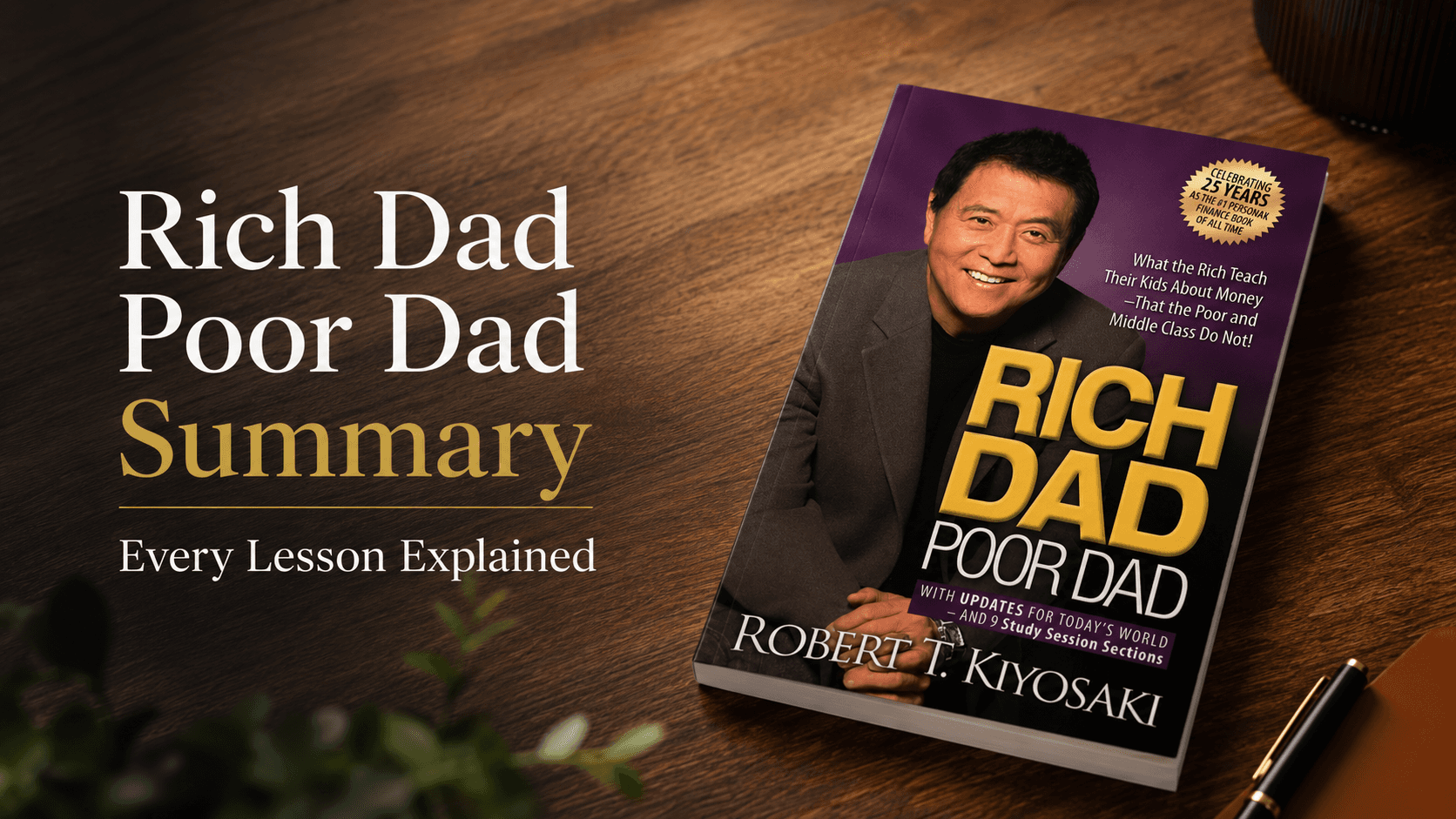


Some books change what you know. A rare few change how you think — and Rich Dad Poor Dad by Robert Kiyosaki sits firmly in the second category. First published in 1997, it has sold over 40 million copies in dozens of languages, and it still tops personal finance lists nearly three decades later. Not because it's a technical manual — it isn't — but because it rewires the way you look at money, work, and everything you were taught about both while growing up.
The setup is deceptively simple. Kiyosaki grew up in Hawaii with two father figures. His biological father — the "poor dad" — was a highly educated man with a PhD, a respected government career, and a lifetime of hard, honest work. He believed in the standard script: study hard, get good grades, find a secure job with benefits, buy a house, climb the ladder. He followed that script perfectly, and he struggled with money until the end of his life.
His best friend Mike's father — the "rich dad" — never finished the eighth grade. He owned convenience stores, restaurants, a construction company, and warehouses across Hawaii, and he eventually became one of the wealthiest men on the islands. He believed the standard script was, at best, incomplete — and at worst, a trap.
The book is the story of what each man taught young Robert, and why their advice pointed in opposite directions on almost everything: work, risk, taxes, houses, education, security. One dad said "study hard so you can find a good company to work for." The other said "study hard so you can find a good company to buy." Same instruction, opposite destination.
I've read it more than once, and what strikes me every time is how little of it is about money mechanics and how much is about mindset — the invisible assumptions that decide your financial life before you ever open a bank account. Below is the full breakdown: every core lesson, chapter by chapter, what it actually means in practice, and my honest take on where the book shines and where it deserves real pushback.
Lesson 1: The Rich Don't Work for Money
This is the chapter that hooks most readers, and it's built on a story from Kiyosaki's childhood. At nine years old, he and Mike asked rich dad to teach them how to become wealthy. Rich dad agreed — on his terms. He put them to work in one of his stores, dusting cans for a few cents an hour. Weeks in, young Robert was furious about the low pay and confronted him, demanding a raise. Rich dad's response was to offer him something worse: keep working, for nothing.
That sounds like a scam until you see what he was doing. Rich dad was deliberately letting the boys feel the two emotions that run most people's entire financial lives: fear and desire. Fear of being broke pushes people into a job. Desire — for a nicer car, a bigger house, a better vacation — makes them spend the paycheck the moment it lands. Then the bills arrive, the fear returns, and they work harder. Kiyosaki calls this loop the Rat Race, and his most uncomfortable observation is that a raise doesn't break it. A raise just upgrades the hamster wheel. More income becomes more spending becomes more need for income. Doctors and lawyers run this race just as hard as cashiers; the wheel is simply more expensive.
Working for nothing forced young Robert to stop thinking like an employee — "what will they pay me?" — and start thinking like an owner: "what opportunity is sitting here that nobody else sees?" The answer turned out to be comic books. The store manager was discarding unsold comics, and the boys got permission to take them, opened a small library in Mike's basement, and charged neighborhood kids admission — earning money from an asset while someone else (Mike's sister, hired for a small wage) ran the room. Two nine-year-olds had built a system that made money without their labor. That's the whole book in miniature.
The takeaway: if your income requires your continuous presence, you don't have wealth — you have a job. The rich focus on building things that pay them whether they show up or not. And the shift starts in your head, long before it shows up in your bank account.
Lesson 2: Why Teach Financial Literacy?
If Lesson 1 is the wake-up call, Lesson 2 is the single most practical idea in Rich Dad Poor Dad — and the one worth writing somewhere you'll see it daily:
Know the difference between an asset and a liability. Buy assets.
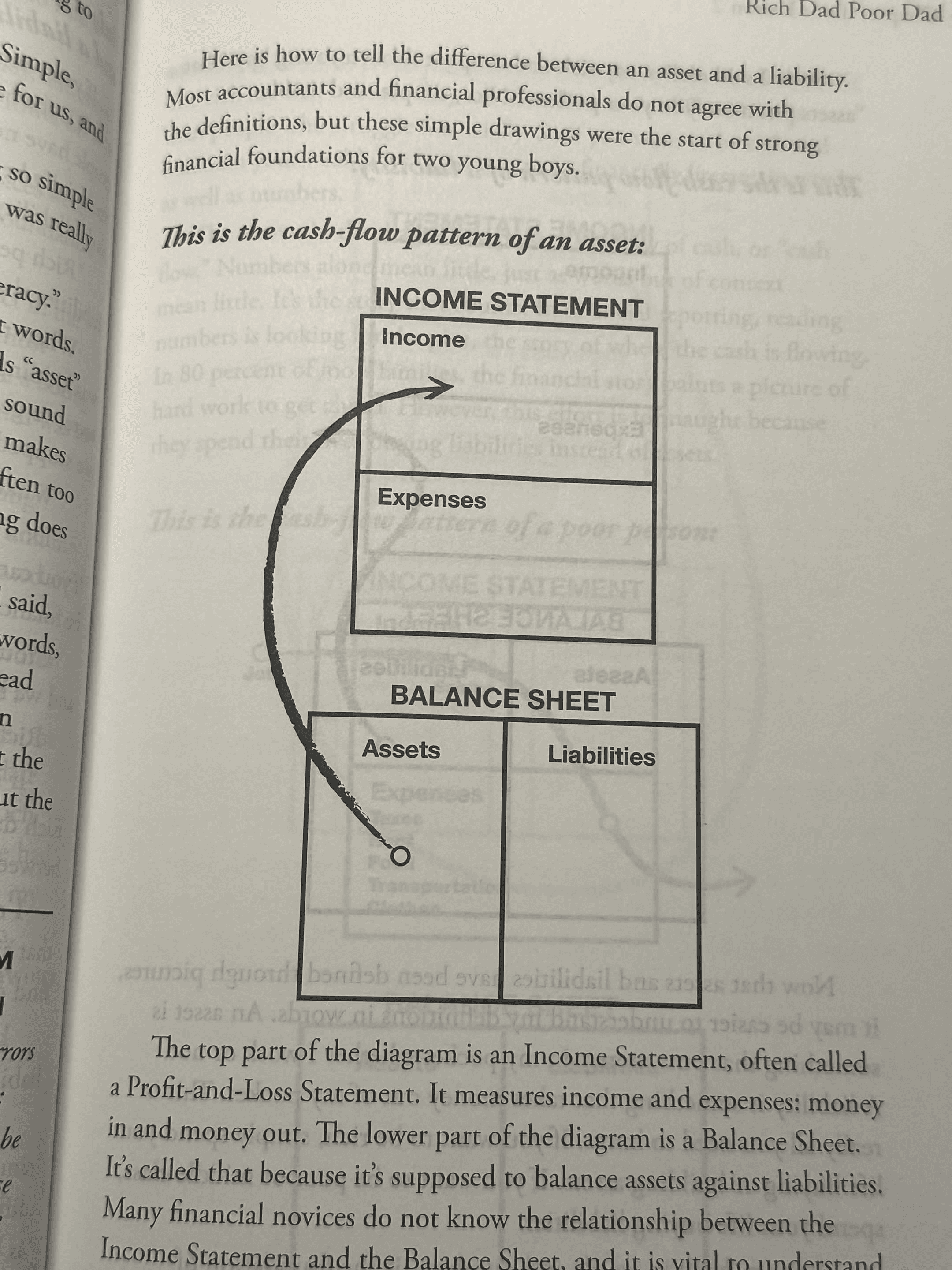
Kiyosaki's definitions are deliberately blunt, stripped of accounting-class complexity. An asset puts money in your pocket. A liability takes money out of your pocket. That's the entire test. A rental property that clears $300 a month after costs is an asset. A boat that costs you insurance, storage, and maintenance is a liability, no matter what the resale market says. He argues that this one distinction — not intelligence, not salary, not luck — is what separates the financial classes: the rich buy assets. The poor have only expenses. The middle class buys liabilities they believe are assets.
That last group is where the book detonates its most famous controversy: your house, Kiyosaki says, is not an asset. Every month it takes money out of your pocket — mortgage interest, property tax, insurance, repairs — and for most families it's the largest purchase they'll ever make, which means their biggest "investment" is actually their biggest expense. People were angry about this claim in 1997 and remain angry today, and the counterarguments are real (homes do appreciate, forced savings has value, you have to live somewhere). But notice what the argument does even if you only half-accept it: it forces you to look at every purchase and ask the only question that matters — does this feed me, or do I feed it?
The chapter also explains why high earners go broke, which might be its most underrated insight. When income rises without financial literacy, spending rises to match it — the bigger house, the leased luxury car, the lifestyle that "fits the salary." Kiyosaki's counter-pattern is simple and strict: the rich buy assets first, and let the income from those assets pay for the luxuries later. The middle class buys the luxuries first, on credit, and never gets around to the assets.
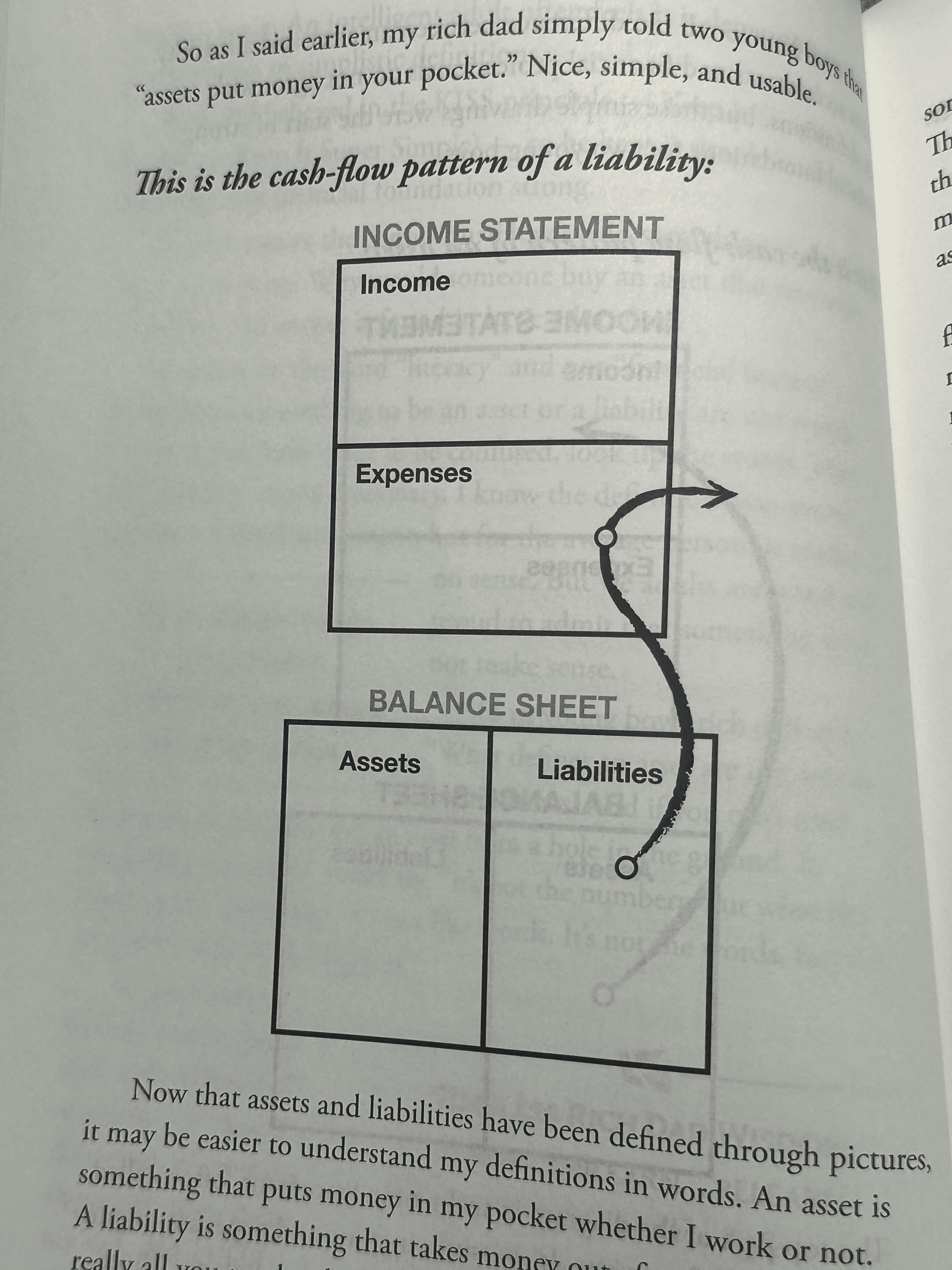
The takeaway: it's not about how much money you make — it's about how much you keep and what you buy with it. Open a note on your phone and list your actual assets by Kiyosaki's definition: things that pay you. If the list is empty, you've just found your project for the next decade.
Lesson 3: Mind Your Own Business
This chapter's title fools people. Kiyosaki isn't telling you to storm into your boss's office and resign. He's drawing a sharper line: your profession is what pays your bills; your business is your asset column. You can be a teacher, a nurse, an engineer — that's your profession. The question is what you own. Most people spend forty years minding everyone else's business: their labor makes the employer rich, their mortgage makes the bank rich, their taxes fund the government — and at the end, their own asset column is empty. They were so busy earning a living that they never built a life-support system that runs without them.
His signature example is McDonald's. Ray Kroc liked to point out that McDonald's wasn't really in the hamburger business — it was in the real estate business. The franchise system was a vehicle for owning some of the most valuable street corners in the world, with burger sales paying for the land underneath. The product funds the asset; the asset is the actual business. Once you see that pattern, you notice it everywhere: airlines that are loyalty programs with wings, gyms that are billing systems with treadmills.
The practical version for a normal person is quieter and much more achievable: keep your day job — and start minding your own business on the side. Be excellent at your profession, collect the paycheck, and systematically route part of it into real assets: index funds, dividend stocks, income-producing real estate, a stake in a small business, intellectual property. Kiyosaki is explicit that this takes years and that the discipline is keeping assets as assets — not selling them to fund lifestyle upgrades the moment they grow. An asset sold for a vacation stops being an asset. An asset left alone becomes an employee that never sleeps.
The takeaway: your job is your income; your asset column is your business. Work your job — but mind your business, every month, starting this one.
Lesson 4: The History of Taxes and the Power of Corporations
This is the chapter where the book gets provocative — and where I'd tell you to read with your critical thinking fully switched on.
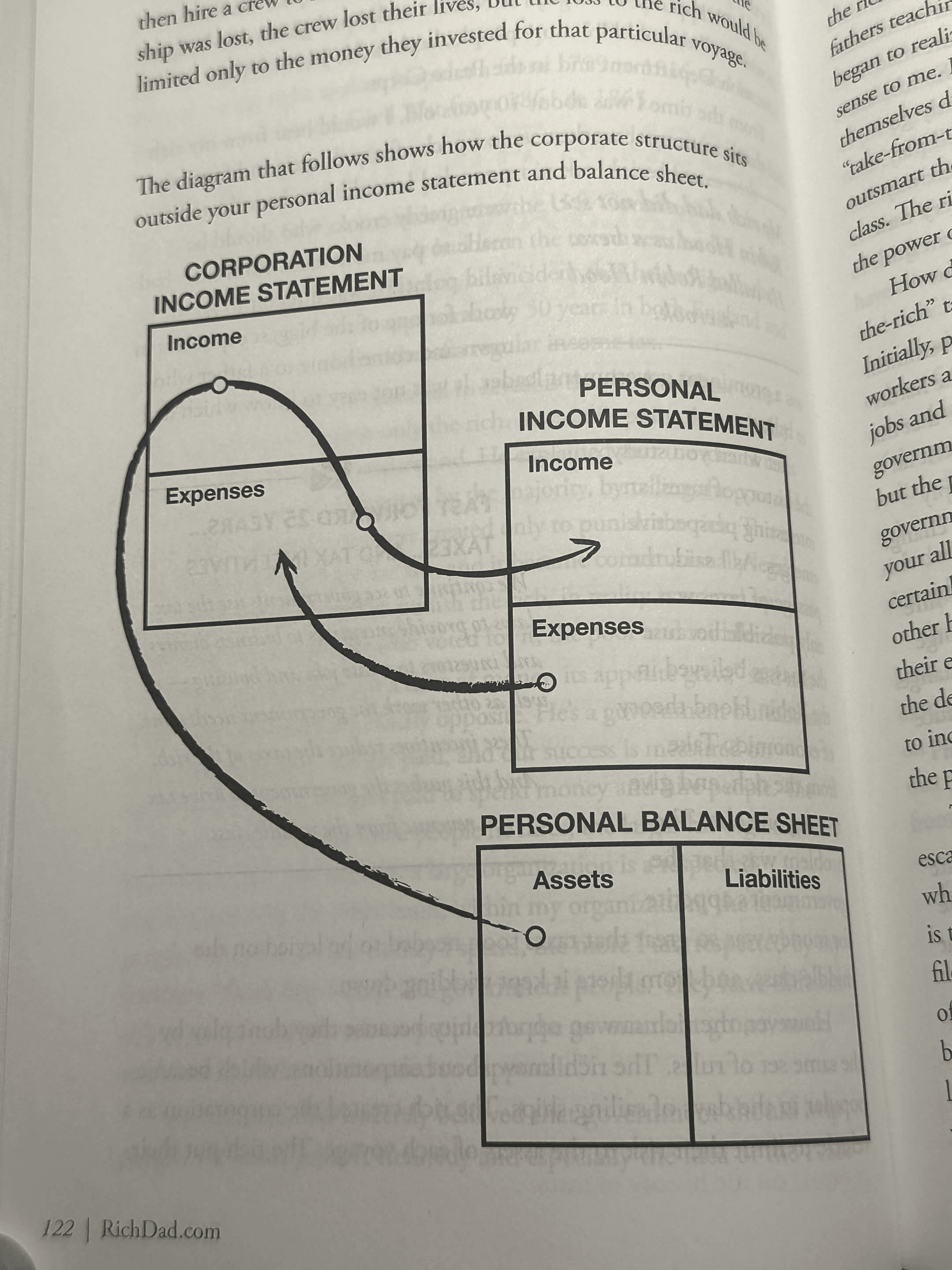
Kiyosaki's historical argument runs like this: income taxes as we know them were originally sold to the public as a way to make the rich pay. England and America both made income taxes permanent (in 1874 and 1913, respectively) with popular support, precisely because the masses believed the burden would fall on wealthy shoulders. But the wealthy responded the way they always had — by getting educated. They hired the accountants and lawyers, mastered the rules, and used the corporation as a legal shield, so the tax appetite of government gradually shifted onto the very middle class that had cheered it on.
His core illustration is the order of operations, and it's genuinely eye-opening the first time you see it. An employee earns, is taxed, and spends what's left. A corporation earns, spends first on legitimate business expenses, and is taxed only on what remains. Same money, opposite sequence, dramatically different outcome over a lifetime. This isn't cheating — it's how the system is written — and Kiyosaki's point is that the rules reward people who bother to learn them.
That learning is what he calls financial IQ, and he breaks it into four kinds of knowledge that compound each other: accounting (the ability to read numbers), investing (the science of money making money), understanding markets (supply, demand, timing), and the law (tax advantages, corporate structures, protection). A person strong in all four sees opportunities and shields that are simply invisible to everyone else.
Now the honest caveat, because this chapter needs one: tax law is local, endlessly complicated, and nothing like the simplified 1997 sketch in the book. Setting up a corporation does not magically make your subscriptions deductible, and misusing these ideas gets people in genuine legal trouble. Don't restructure your life off one chapter — talk to a licensed accountant in your own country. But the meta-lesson survives all of that intact: what you keep is determined by knowledge most people never bother to acquire.
The takeaway: it's not what you make; it's what you keep. The rules of the money game are written down and legal to learn — and almost nobody reads them.
Lesson 5: The Rich Invent Money
Here Kiyosaki makes his most philosophical claim: in the real world, the most powerful asset you have isn't capital — it's financial intelligence paired with boldness. Opportunities, he argues, are everywhere, all the time. They're simply invisible to minds trained to look only for safety. Where an untrained eye sees a run-down house in a mediocre neighborhood, a trained one sees a below-market purchase, a renovation margin, a rental yield, and two different exit strategies. The house is the same. The observer is different.
He illustrates this with deals from his own life — buying distressed properties during the early-1990s Phoenix downturn, when foreclosures flooded the market and frightened sellers accepted fractions of prior value. While the crowd saw catastrophe, trained investors saw the sale of the decade. Markets, he notes, hand out these windows regularly; panic is practically a scheduled event. The people who profit aren't luckier — they're prepared, liquid, and emotionally capable of buying when everyone around them is selling.
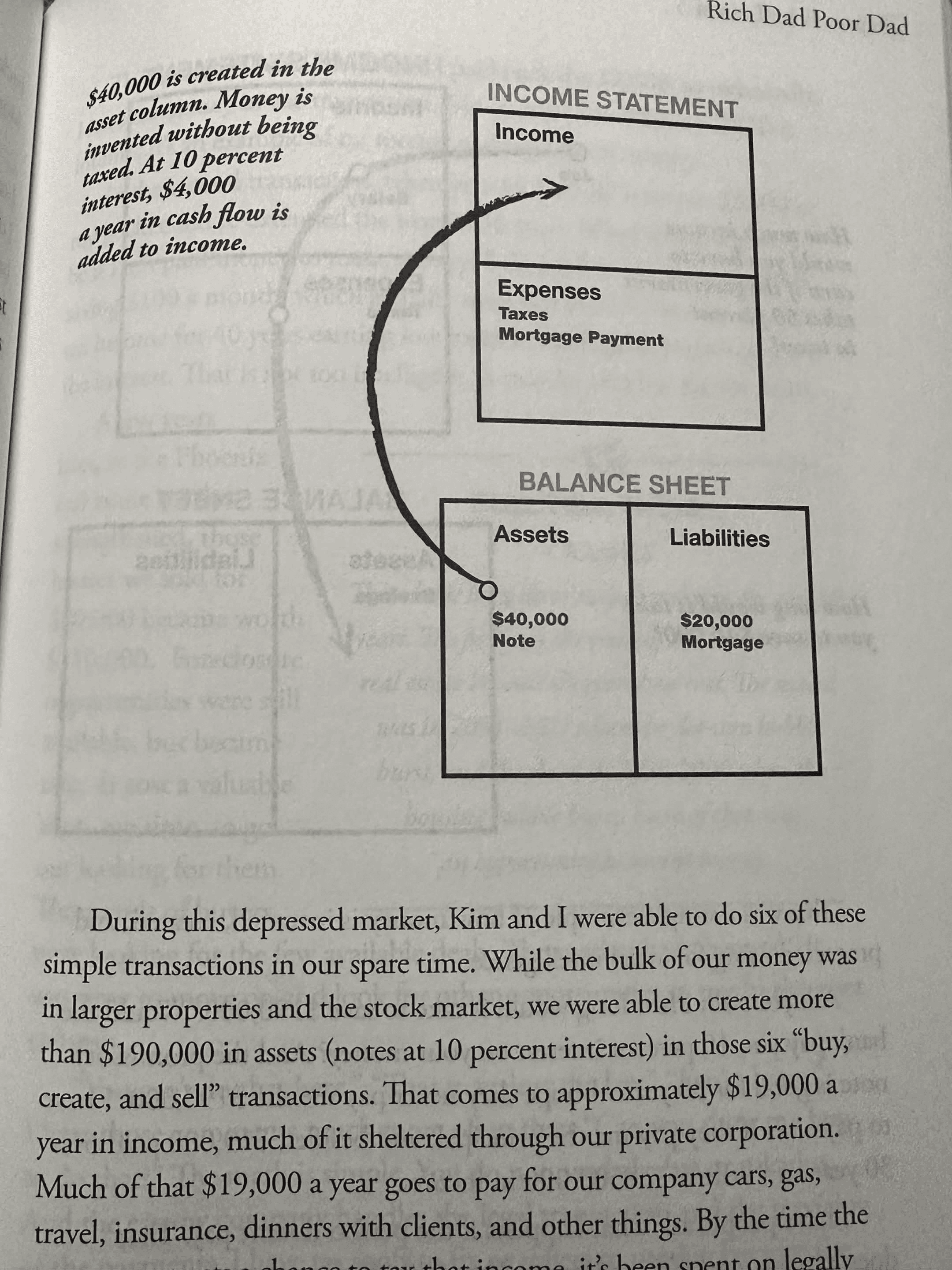
Kiyosaki also splits investors into two types, and the split is more useful than most investment advice. The first type buys packaged deals: mutual funds, REITs, whatever their bank offers. Nothing wrong with it — it's how most people should start. The second type creates deals: they find undervalued assets, raise the money, and organize people smarter than themselves around the project. This second type needs three skills — spotting the opportunity others missed, financing it, and assembling intelligent people — and captures dramatically more upside in exchange for dramatically more required knowledge.
And then there's the idea from this chapter that has stayed with me longest: it's rarely the smartest people who get ahead — it's the bold ones. Everyone knows someone brilliant and broke, sitting on the sidelines waiting to feel certain. Certainty never arrives. Every real opportunity comes wrapped in doubt, and the trained-but-timid watch the untrained-but-brave walk past them again and again.
The takeaway: money is not the scarce resource — trained perception is. Build the financial mind first, keep some powder dry, and be brave enough to act when the window opens. It always opens.
Lesson 6: Work to Learn — Don't Work for Money
The final lesson flips the standard career question on its head. Most people evaluate a job by asking "what does it pay?" Kiyosaki argues the better question — especially in your first decade of working — is "what will it teach me?"
His own resume makes the argument for him. After college, he joined the Marine Corps and learned to lead people under pressure — a skill no classroom sells. Then he took a sales job at Xerox, not because he loved copiers, but because he was painfully shy, terrified of rejection, and knew Xerox ran one of the best sales training programs in America. He deliberately chose discomfort as a curriculum. Neither move maximized his short-term salary; both built the skill stack — leadership, sales, communication — that made everything he did afterward possible.
His poor dad embodied the opposite path: the trap of specialization. Highly educated, deeply expert in one narrow field, and therefore completely dependent on the one institution that valued that expertise. When his government career collapsed after a political dispute, he had a lifetime of credentials and nowhere to take them. Job security, Kiyosaki concludes, is a comforting story we tell ourselves; skill security is the real thing, and it only comes from breadth.
The formula he offers is knowing a little about a lot: sales, marketing, basic accounting, investing, law, managing people, public speaking. Mastery of none required — working knowledge of all, so that you can build something and never be at the mercy of a single employer's org chart. And he's blunt about which skill matters most and gets avoided hardest: selling. People recoil from it, associate it with sleaze, and structure entire careers around never doing it — while everything in life, from job interviews to raising kids to raising capital, is a sale. The management skills he says actually matter — managing cash flow, managing systems, and managing people — are learnable at almost any job, if you're paying attention to the right things.
The takeaway: especially early on, choose work for the skills, not the paycheck. A slightly lower salary that teaches you to sell, lead, or build is the best-paying job you'll ever have — the returns just arrive later.
Lesson 7: Overcoming Obstacles
The six lessons above tell you what to do. The book's final teaching answers a harder question: if the path is this clear, why do so few people walk it? Kiyosaki's answer is that even financially literate people are stopped by five internal obstacles — and he treats naming them as the last, essential lesson.
Fear. Not fear of losing money in general — everyone has that, including the rich — but what you do with the fear. Most people let the fear of loss keep them from ever starting; they play it so safe that they guarantee mediocrity. The rich feel the same fear and act anyway, because they know losing is part of winning. Kiyosaki's sharpest observation here is about Texans: they don't bury their failures, they turn them into monuments. The Alamo is a story of a devastating loss retold as inspiration. Failure inspires winners and defeats losers — the event is the same; the response is the difference.
Cynicism. The "what if" chorus — what if the economy crashes, what if the tenant destroys the place, what if I lose everything? Doubts and the noise of pessimistic friends paralyze people into inaction, and cynics end up criticizing from the sidelines while the market passes them by. His antidote is to notice that "I can't afford it" and "it'll never work" are usually laziness dressed up as prudence. Analysis is looking closely and finding the opportunity inside the risk; cynicism is looking away and calling it wisdom.
Laziness. Not couch laziness — busy laziness. The most common form, he argues, is people who stay frantically occupied with work, email, and errands precisely so they never have to face their finances, their health, or their relationships. Busyness is the most respectable way to avoid what matters. His cure is a little greed, reframed: instead of "I can't afford it," ask "how can I afford it?" The first phrase shuts the brain off; the second forces it to work.
Bad habits. The habit that decides everything is order of payment. Most people pay everyone else first — the landlord, the bank, the tax office — and save whatever's left, which is nothing. Kiyosaki's rule is pay yourself first, even under pressure, because the pressure itself becomes the motivation to earn more. Your outgoing bills become the drill sergeant that forces your asset column to grow.
Arrogance. The final trap catches smart people specifically: using confidence to hide ignorance. What I know makes me money, he says, but what I don't know — and pretend to know — loses it. The fix is cheap and humbling: when you catch yourself bluffing on a subject that matters to your wealth, find a book or an expert and actually learn it.
The takeaway: the biggest obstacles between you and wealth aren't in the market — they're between your ears. Fear, cynicism, laziness, habit, and arrogance stop more people than any recession ever has. Name yours, and you've done half the work.
My Honest Take: Is the Book Still Worth Reading in 2026?
Yes — with clear eyes about what it is and what it isn't.
What it is: the best mindset book on money ever written for beginners, and it isn't particularly close. The asset-versus-liability framework alone has probably done more for ordinary people's finances than a shelf of technical manuals, because it's simple enough to actually change behavior on a Tuesday. If you grew up hearing "go to school, get a safe job, buy a house" and something about that script always felt incomplete, this book will articulate exactly what — and that experience of having your assumptions named and challenged is genuinely valuable, whatever you go on to do with it.
What it isn't: a how-to guide. Kiyosaki tells you how to think, not what to do — there are no worked examples, no step-by-step plans, and no numbers you can copy. Some of his real estate stories describe a 1980s–90s market with conditions (and prices) that no longer exist. Critics have long questioned how literally the two-dads story should be taken, since the rich dad's identity was never publicly verified — reasonable people read it as a parable rather than a memoir. And the tax chapter, as noted, simplifies things a licensed accountant would wince at. Read it for the frameworks; get your tactics from technical books and qualified professionals afterward.
Honestly, that's the correct order anyway. Tactics without the mindset shift is how people day-trade themselves broke. Rich Dad Poor Dad fixes the foundation first, and foundations are what last.
Who Should Read It
Anyone at the start of their money journey. Students, first-jobbers, anyone who's never been taught what an asset is. As a first finance book, nothing beats it — it creates the appetite that makes every later, more technical book digestible.
Career professionals who feel stuck in the Rat Race. Good salary, growing expenses, nothing actually building. Lessons 1 and 3 will sting in a productive way, and Lesson 2 hands you the exit map.
Parents. Underneath everything, this is a book about what we teach children about money — deliberately or by accident. It will change some dinner-table conversations, which is arguably its highest use.
If you already own rental properties and read balance sheets for fun, you've absorbed most of its ideas secondhand through the thousand books it inspired. But it's a fast read, and the source is sharper than the summaries — including this one.
You can grab Rich Dad Poor Dad on Amazon — the anniversary edition includes updated reflections from Kiyosaki on how the lessons have aged. It's the kind of book you'll finish in a weekend and argue with for years, which is precisely what makes it worth the cart. Just remember the deal you're making with it: it hands you the map, but the walking is yours.
Keep reading
Related articles


WorthTheCart?
WorthTheCart helps shoppers compare products before anything hits the cart.
WorthTheCart may earn a commission from qualifying purchases. This does not affect our editorial opinions.
© 2026 WorthTheCart. Built for clearer buying decisions.
worththecart@proton.me